Rack and pinion steering has quietly come to dominate the automotive world. Today, it is standard equipment on all vehicles, from compact city cars to large SUVs. This system is elegant in its simplicity. The protective metal tube contains a series of pinion gears that convert hand movements into physical movements.
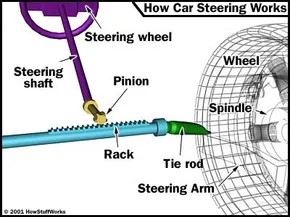
The heart of the system is the rack-and-pinion pinion gearset. The rack is an elongated pinion gear whose teeth are the same length. It is located inside a metal tube with both ends sticking out. Attached to these ends are tie rods. These rods act as a link between the inner mechanism and the outer world.
The action starts from the top. The pinion gear is attached to the steering shaft which extends down from the steering wheel. When you turn the wheel, the shaft turns the pinion gear. The pinion gear engages the teeth of the rack and pushes the rack from side to side. This linear movement is transmitted through the tie rods to the steering arms, which is connected to the wheel spindle.
This mechanism performs two important functions simultaneously. First, convert the rotational motion of the steering wheel into the linear motion needed to turn the wheel. Second, it provides pinion gear reduction. This reduction is key. It makes turning the wheel much easier than attaching the wheel directly to the shaft.
Most modern vehicles require three or four turns of the steering wheel to go from one lock to another. That is the range from the far left turn to the far right turn. This range is defined by the steering ratio.
Understanding Steering Ratio
The steering ratio is a simple mathematical relationship. Compare turning the steering wheel to the amount the car’s wheels actually change direction. If one rotation of the steering wheel (360 degrees) causes the wheels of the car to turn 20 degrees, the ratio is 18:1.
A larger number means that more wheel revolutions are required for a given angle. But they also mean less physical work. The gear reduction does the heavy lifting.
This is where driver preference comes into play. Lighter and sportier vehicles typically have a lower steering ratio. The smaller the ratio (e.g. 12:1), the faster the car reacts. You make a small input, and the wheels react immediately. This is essential for agility in performance cars. These vehicles are light enough to allow drivers to handle the increased stress without feeling like they are floating without power assistance.
Larger trucks and family sedans often use higher ratios. The priority here is stability and a lower workload when driving on the highway. You don’t need twitchy response; Steady control is required.
Some manufacturers have found a reasonable middle ground with variable-ratio steering. This system modifies the rack-and-pinion gearset. The teeth on the rack are not spaced evenly. In the middle, the gap between the teeth becomes more detailed. This provides the quick response needed when initiating a turn. As the steering wheel approaches its rotational limit, the pinion gear spacing becomes coarser. This reduces the effort required to fully lock the wheels, reducing parking and tight maneuvers.
Power Rack-and-pinion Systems
Adding power assistance to the equation changes the design a bit. Most drivers rely on power rack-and-pinion systems. These units integrate hydraulic or electrical assistance directly into the frame assembly. The basic principle remains the same. The pinion still moves the rack. But today, hydraulics and electric motors provide the muscle.
This help is variable. It varies according to the speed of the vehicle. The greatest assistance is provided when driving at low speeds, such as parallel parking. You can turn a heavy wheel with one finger. Power assistance decreases when driving at high speeds. This prevents the car from feeling fuzzy or too sensitive to small steering inputs. The feedback becomes heavier and affects the driver
Auxiliary mechanism
This is not magic. Hydraulic systems steering wheel the heavy lifting.
There is a cylinder inside the rack housing. In the center of the cylinder is a piston. The piston is locked to the rack itself. Therefore, when the piston moves, the rack also moves. Period.
Fluid enters through two ports. It’s on the left. It’s on the right.
Here’s the trick: pump higher-pressure fluid on one side of the piston. The pressure difference forces the piston to slide. The slide pushes the rack. Suddenly, the steering wheel no longer feels like turning a millstone.
This is a system that helps hydraulic pressure. Just tell them that.
But how does the liquid get there? How does the system know which way you want to turn before you’ve even moved the wheel much? Later, we will dig into the pump, the valves, and the logic behind the flow.
First, let’s move away from hydraulic rags and look at another significant player in the steering arena.