It’s not just about making cool trucks. It’s about making legends.
Spencer Murray wanted more than just a custom vehicle. He wanted a story that could be printed. As the founding editor of Rod & Custom magazine, Murray had a vision that bordered on obsessive. He took an ordinary factory-new 1954 Chevrolet pickup truck cab and turned it into a rolling laboratory for the best craftsmen in the business. The result? Dream Truck. This wasn’t a one-off build hidden in a garage. This is a public experiment. A five-year adventure that began in September 1953 saw his every punch, part and hammer blow in the pages of magazines.
The goal is simple, but ambitious. Murray wanted to see if he could pull together an improbable team of craftsmen and get them working towards a single, wild, custom vision. At first, his daily driver was a 1950 Chevrolet pickup truck, but the real magic happened when he set his sights on the ’54 cab. The development process became the content. A few months later, readers didn’t just see the finished product; They watched it unfold. They saw the mistakes. They saw victory.
Who built it? This list is like a who’s who of 1950s hot rod history.
Sam Gates started it all by cutting the roof line. He removed 3-3/8 inches from the top. This is not a quick fix. That changes the entire stance of the vehicle. But he didn’t stop there. He also sectioned the body by 5-1/3 inches. Segmentation involves cutting the body vertically, removing the strips and welding it back together to reduce the height without changing the shape of the roofline. It’s technical, messy and requires serious skill.
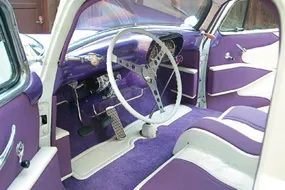
Then came the rest of the heavy lifting. Neil Emory and Clay Jensen of Valley Custom took the lead. They finished the chop and sectioning work that Gates started. But their work doesn’t end with metal. They made the dashboard by hand. In an era before plastic injection molding was cheap and easy, molding a metal dashboard by hand was a craft. It requires heat, hammer and patience.
カリー・デイハスがりますますてるすてます。 He completed the dashboard and did some smart work.
Why is this important today? The Dream Truck didn’t just look good. It taught a generation how to think about customizing. It showed that a truck could be more than a workhorse. It may be art. It can also be used as a canvas.
The project lasted for 5 years. Dozens of articles. All the major custom technologies of the time were tested in this game. If you want to understand how modding culture changed from simple modding to complex body sculpting masterpiece, start here. Thanks to the tenacity of Spencer・Mary. Gaye, Emery, Yansen, Davis all showed up and worked.
What

The Team Behind the Metal
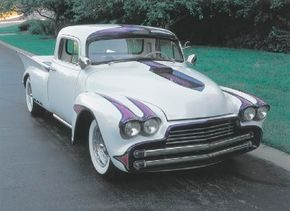
The transformation didn’t happen in a vacuum. It took a village of skilled hands to turn raw steel into a rolling sculpture. Gene Winfield started by radiusing the front-wheel cutouts and sectioning the hood, smoothing out the lines so they flowed. Then came Barris Kustom. They slapped on quad headlights, added scoops to the roof and hood, and fashioned the front and rear grille openings by molding together ’54 Studebaker front pans. It was a patchwork of genius.
Bob Hirohata handled the lighting, installing clear front and translucent red rear turn-signal lights that gave the truck a distinct, futuristic glance. Later, Bob Metz stepped in to form the wild, scratch-built canted fins that became the truck’s signature silhouette. Each of these craftsmen was integral. Without them, you just have a modified pickup. With them, you have a legend.
Under the Hood: The First Small-Block Chevy Swap
Looks only got you so far. To make the Dream Truck perform as well as it looked, Spence and his team tackled the mechanicals. They lowered the stance by relocating the rear spring perches and installing an airbag suspension system hooked to a semi-elliptical front-spring setup. It was aggressive, it was low, and it handled the show circuit with stability.
But the real headline was what sat under that sectioned hood. The Dream Truck holds the distinction of being the first vehicle to receive a documented small-block Chevy engine swap. This was huge. The new-for-’55 V-8 was about to become a milestone engine in the rod and custom world, but here, in this truck, it was already proving its worth. It wasn’t just about power; it was about validation.
Paint, Travel, and Disaster
As the project evolved, so did its skin. The truck didn’t stay in one place visually. It was first shown in gray primer with white scallops. That soon changed to metallic lavender with Dean Jeffries-applied scallops. Then came bright white. Finally, it settled on metallic lime gold with a fresh burgundy red scallop design. Each version was a hit. Spence campaigned the truck at car shows across the United States, and uncounted numbers of custom fans got to see it evolve in real-time.
This history alone should have cemented the Dream Truck in custom car lore. But fate had other plans. In 1958, disaster struck. A tire blew on the pickup towing the Dream Truck. The iconic custom flipped end over end. It was a horrible crash.
The mangled bodywork was trailered back to California. George Barris, ever the showman, displayed the damaged vehicle at car shows. He kept the wreck alive, showing the scars as part of the story. But the end was near. Spence parted it out and sold the banged-up vehicle to a buyer who never fully paid for it. The truck vanished into the shadows of the industry’s uncollected debts.
The Long Hunt and Return
The Dream Truck disappeared for nearly two decades. It wasn’t until the late 1970s that Bruce Glascock found its worn-out hulk in California. It had taken him a decade of searching to locate it. Once he acquired it, he asked Spence to help guide the restoration. It wasn’t a quick fix. Months of difficult work went into bringing it back.
They returned the truck to its classic white paint livery, stripping away the lime gold and burgundy to reveal the original spirit. The restored Dream Truck was then placed on the Darryl Starbird show tour, proving
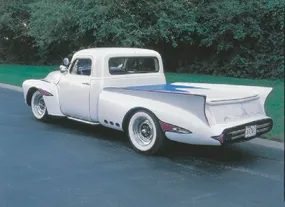

The story changes in 1986 when Bruce hands the truck over to Kurt McCormick, a collector deeply rooted in the world of custom cars. McCormick didn’t just park the vehicle; he got his hands dirty. He rebuilt the transmission and improved the front suspension, effectively giving the machine a second life before reintroducing it to the scene.
Since then, the truck has traveled far beyond its original roots. It has been featured in several locations across the United States. Notable appearances include a major cultural presentation at the Oakland Museum and a subsequent stint at the Starbird’s Rod & Custom Car Hall of Fame Museum in Afton, Oklahoma.
These exhibitions were about more than the presentation of metal and paint. They emphasized the cooperative spirit of the time. Thanks to the combined efforts of Bruce Glascock, Kurt McCormick and Spence Murray, the work of the top customizers of the 1950s has been preserved. The truck is considered a surviving artifact of this golden age.
Exploring the heritage of hot rod and custom cars
For those interested in the larger context of this machine, there are several resources covering the history of these vehicles. The evolution of hot rods and custom cars offers a glimpse into American car culture.
“The joint work of the top customizers of the 1950s has been preserved well.”
This preservation allows enthusiasts to explore the techniques and styles that defined this era. The truck’s journey from the original build by Bruce to restoration by McCormick to subsequent museum displays provides a clear timeline for evaluating and servicing these vehicles.
- History of Hot Rods : Understanding the origins and evolution of modified vehicles.
- Custom Car Profiles : Detailed information on the most important models and their creators.
- Hot Rod Profiles : Exclusive insights into iconic hot rod models and performance modifications.
The truck’s presence in these circles ensures that the stories behind it are not lost. Each display adds a layer to the origin. The work of Glascock, McCormick and Murray is still a testament to the skill and passion of their time. The vehicle still serves as a benchmark for modern builders and historians.
There’s still a lot to figure out about the specific changes McCormick made to the suspension. How these changes affected the truck’s handling on the show circuit is still a detail worth examining. The connection between the past and the present can be seen in this hobby. This can be seen in the lines of the body and the precision of the engine compartment.
The story doesn’t end with the display of the truck. It still lives on in conversations at car meets, on the pages of magazines and in the minds of those involved in its design. Legacy is active and not static. It affects new builds even today.