


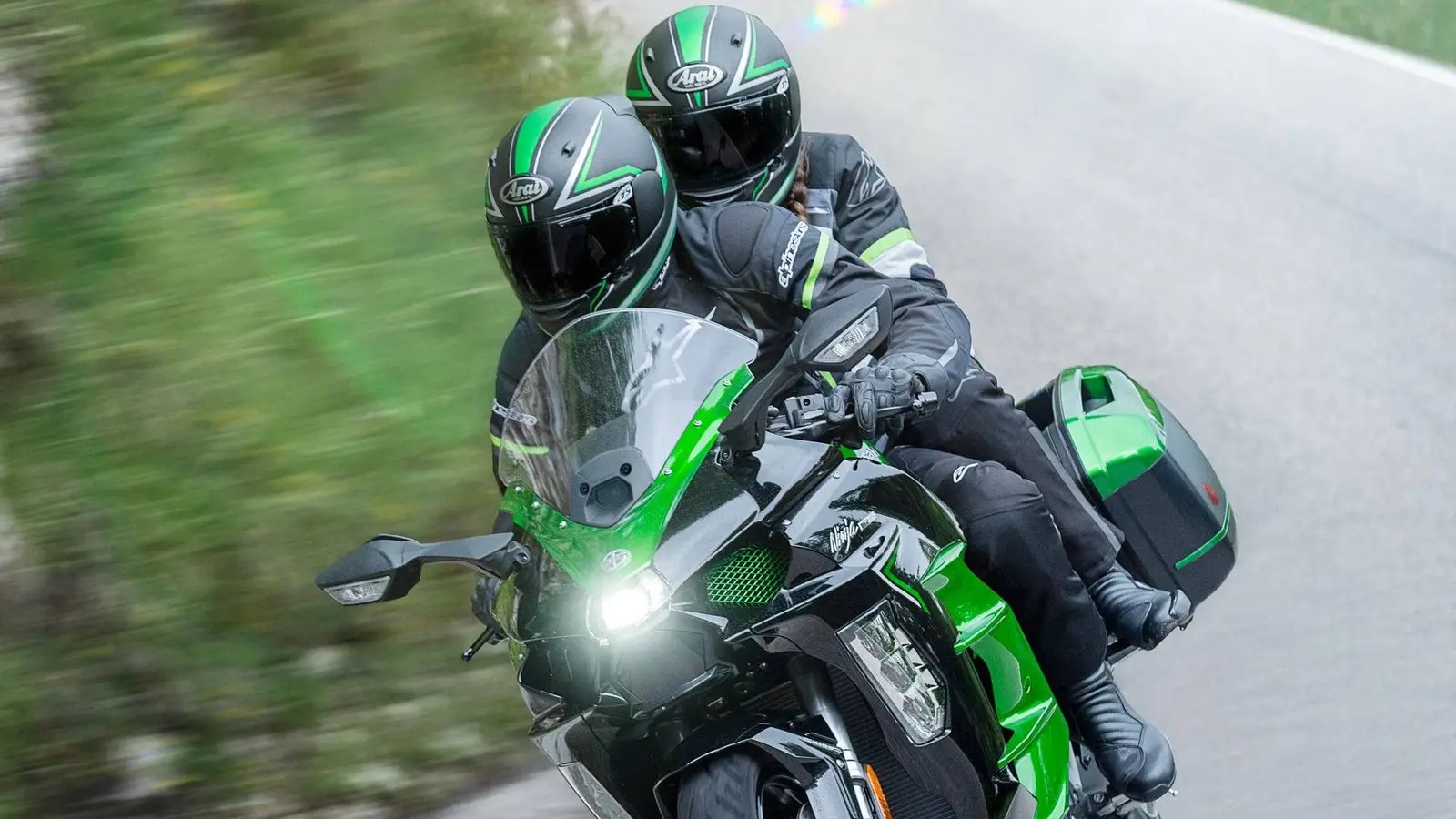
You have to choose. That’s the unspoken contract you sign when buying a motorcycle.
Go hypersport, and you ride on the edge of your seat. Your wrists ache. Your knees scream. It’s fun until it’s not, especially on a Tuesday commute or a six-hour highway slog.
Go sport-touring, and you float. You’re comfortable. You’re safe. But the bike feels… polite. The engine is detuned. The chassis is soft. It doesn’t inspire fear, so it doesn’t inspire passion.
The industry has treated comfort and performance as a zero-sum game for decades. Max one, lose the other.
The Kawasaki Ninja H2 SX SE suggests that binary is a lie.
A Supercharger in a Sport-Tourer Body?
Pricing at $29,999 MSRP, the Ninja H2 SX SE isn’t cheap. But it’s also not just an expensive accessory bike. It’s a supercharged hypersport-tourer.
That distinction matters. It’s not a naked H2 wearing a windscreen and luggage racks. It’s a distinct machine engineered around real-world usability while retaining the DNA of Kawasaki’s wild H2 hyperbike lineage.
The core of this synthesis is the engine.
Beneath the bodywork sits a 998cc inline-four equipped with a belt-driven supercharger. The specs scream: 207 horsepower and 101 lb-ft of peak torque. Those numbers headline press releases. But the real magic is in the delivery.
Natural aspiration, like on a Ducati Panigale V4 or a Yamaha YZF-R1M, demands you rev it out. You have to chase the power. You have to fight the tachometer.
The supercharger doesn’t care how fast you’re spinning. It forces air in regardless.
That means the H2 SX SE loads up early. Third gear at 3,500 RPM has shove. The torque curve is flat and broad. It pulls harder when you’re rolling on, making high-speed passing effortless and urban acceleration snappy. It’s performance that doesn’t vanish until the rev limiter screams.
“The supercharger on the H2 SX SE creates a driving experience that is defined by immediate thrust rather than top-end screams.”
Why Ergonomics Matter More Than Horsepower
Numbers on paper don’t save your shoulders from pain. Ergonomics do.
Kawasaki lowered the footpegs and widened the knee angle compared to the track-focused H2. The seat height sits at a manageable 32.9 inches. For a six-foot rider, the cockpit opens up. You aren’t folded into a crouch. You’re seated.
Curb weight lands around 589 lbs. Heavy? Yes. But planted is good.
On the highway, a light bike gets tossed by crosswinds. This bike feels substantial. The trellis frame was reinforced to handle two-up riding and 40+ pounds of luggage without becoming vague. The front end stays precise even when you’re carrying extra mass up a sweeping on-ramp.
It’s not a Gold Wing. It won’t make you forget you’re on two wheels. But it won’t dismantle your spine in the process, either.
Electronics That Work Without Annoying You
The “SE” badge unlocks semi-active suspension. Kawasaki Electronic Control Suspension (KECS).
Based on Showa’s Skyhook tech, it reads wheel speed and chassis movement dozens of times per second. It adjusts damping in real time.
You can toggle between comfort and sport modes, but the system handles the micro-adjustments underneath. A pothole hits? It soaks it before it jars your spine. Lean hard? It firms up to support the chassis. It’s like a camera gimbal for your motorcycle.
Braking is equally serious. Dual 320mm discs. Brembo Stylema radial monobloc four-piston calipers. Intelligent ABS. These aren’t tourist bike components. They’re track-derived hardware that stops the weight without the harsh edge typical of touring brakes.
Then there’s the Quick-shifter. Standard equipment. Bi-directional.
Clutchless upshifts. Smooth downshifts assisted by a slipper clutch. Sounds like a spec sheet detail until you’re stuck in stop-and-go traffic or winding through mountain switchbacks for six hours. The fatigue reduction is tangible. You spend less energy shifting, more energy riding.
Advanced Rider-Assistance as Fatigue Management
We often talk about radar and cruise control as “tech features.” On the H2 SX SE, they’re comfort features.
Bosch-based radar sensors power the Advanced Rider-assistance System (ARAS). Adaptive cruise control maintains your distance in heavy traffic. You stop worrying about the guy tailgating you five feet back.
Blind spot detection flashes in the TFT display before a lane change gets dangerous.
This isn’t just safety. It’s mental load management. Long rides break your focus. Constant mirror checks break your flow. Removing the need to hyper-vigilantly monitor every inch of airspace around you reduces fatigue. You arrive fresher.
The 6.5-inch TFT display runs Kawasaki’s SPIN connectivity. Turn-by-turn navigation. Call alerts. All mounted high and readable. No fumbling for a phone at a red light. No glancing down.
Heated grips are standard, too. Numb fingers lead to sloppy inputs. Keep your hands warm. Keep your focus sharp.
Cornering Lights That Actually Help
Night riding on canyon roads is a game of inches and visibility.
Standard headlights illuminate the straight line. They don’t help you see the inside of the apex as you lean.
The H2 SX SE features lean-angle-sensitive LED cornering lights. As you lean, the lights activate progressively, throwing illumination into the corner before your headlight beam catches it.
It’s a subtle difference. But when you’re carrying speed into a decreasing-radius turn in the dark, that extra beat of visibility can be the difference between seeing the road and finding it mid-lean.
The Verdict on the Hypersport-Tourer
The H2 SX SE won’t out-plush a Honda Gold Wing on a cross-country trek. It won’t lap a track faster than an R1M or a Panigale V4 S.
It refuses to pick a lane.
It’s a motorcycle that can chase a canyon wall on Saturday with genuine urgency. Then turn around and log 400 miles of highway on Sunday without making you choose between comfort and performance.
For the first time, the compromise feels like a feature.
Is it the perfect motorcycle? Perfection is boring. It’s heavy. It’s complex. It’s aggressive enough to wake you up but soft enough to let you live with it.
Maybe that’s what freedom actually feels like.


