You want the cabin air. You want the lake water. You definitely don’t want the cop on the side of the highway staring at your trailer’s width.
Camping is supposed to be an escape from the cubicle, the boss, and the endless noise of modern life. It’s about bonding with the kids. It’s not about getting cited for violating obscure state regulations because you assumed Georgia’s rules were the same as South Carolina’s. One memory you definitely don’t want to add to the family album is being pulled over because your rig is three inches too wide.
The Weight and Braking Reality
Here is the hard truth: towing changes everything about how your vehicle handles. Momentum is a cruel master. The more weight you drag behind you, the longer it takes to stop. It’s physics, not opinion.
Most states don’t let you get away with relying solely on your tow vehicle’s brakes once you cross a specific weight threshold. That limit varies. In some jurisdictions, you need trailer brakes for loads as light as 1,500 pounds (680 kg). In others, the cutoff is higher. But if you ignore these requirements and get into an accident, insurance companies won’t care about your “out-of-state” ignorance. You’ll be in hot water. Literally and figuratively.
Speed matters too. Towing is dangerous at high speeds. Every state has a max towing speed limit. It’s often lower than the standard highway limit. In some places, it drops to 45 mph (72 kph). You might not get pulled over for going 50 in a 45 zone while towing, but if you hit a deer and your rig jackknifes because you didn’t account for the reduced braking power, the fine is the least of your worries.
Crossing State Lines: A Legal Maze
One of the biggest misconceptions among new towers is that traffic laws are uniform. They aren’t. You can be a law-abiding citizen in Alabama and instantly become a felon in Mississippi just by crossing a border.
Let’s look at the specifics. If you drive from Alabama into Mississippi, the maximum legal towing speed might drop by 10 mph (16 kph). Suddenly, your cruise control is illegal.
Width is another trap. The maximum legal width of a trailer might narrow by six inches (15 cm) in the next state. If you’re pushing the limit, you’re now non-compliant.
Weight limits shift too. A state might lower the weight threshold for mandatory brakes by 1,000 pounds. You thought you were safe? Not anymore.
Even hauling multiple trailers is a minefield. You might be totally legal in South Carolina hauling a camper and a Jet Ski on a separate dolly. Cross into Georgia, and that second setup is a ticket. You need to know the trailer towing guidelines for every single state you plan to drive through. If your trailer exceeds legal dimensions in a specific state, you might need a special oversize/overweight permit to travel there.
The Non-Negotiable Safety Gear
Before you worry about specific state quirks, you need to meet the federal baseline. No matter where you are in the U.S., your trailer must have these basics:
- Taillights : Operable rear lights are mandatory. Period.
- License plate light : You need to see that plate at night. The plate itself must be illuminated.
Beyond these bare necessities, the vast majority of states require additional safety equipment. Skipping these is risky.
- Safety chains : These must cross in an ‘X’ shape under the hitch. If the ball mount breaks or the hitch fails, the chains catch the trailer. Without them, you’re dragging a runaway projectile.
- Brake lights : Your trailer is opaque. Drivers behind you can’t see your brake lights through your cargo. Your trailer needs its own brake lights to signal stops and prevent rear-end collisions.
- Clearance lights : Required if your trailer exceeds certain width limits. They mark the outer edges of your rig.
- Turn signals : If your vehicle’s turn signals are blocked by the trailer, the trailer must have its own.
- Reflectors : These are cheap, effective, and vital for keeping your large trailer visible in low-light conditions.
State-Specific Add-Ons
Some states demand more than the basics. These are the extras that keep you out of trouble in stricter jurisdictions.
- Breakaway brakes : These are independent power brakes that activate automatically if the trailer separates from the tow vehicle. They’re a critical backup to safety chains.
- Flares or reflective triangles : Keep these in the car. If you have an accident, you need to warn approaching traffic.
- Tie-downs : If you’re loading gear that could shift or fall off, you need to secure it at multiple angles. Loose cargo is a hazard to everyone on the road.
Dimensions That Matter
You can’t just buy the biggest camper on the lot. States cap dimensions to keep traffic flowing and bridges safe.
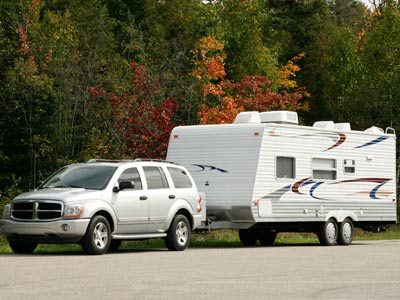
- Width : Typically restricted to 8 or 8.5 feet. That’s it. Go wider, and you need permits.
- Length : The total length of the vehicle-trailer combination might be capped at 53 feet (16 meters). Some states restrict the trailer itself to 35 feet (10.7 meters) or less.
- Height : Often capped between 12 and 14 feet (3.7 to 4.3 meters). Tall campers hit low overpasses. It happens.
Planning a trip isn’t just about packing hot dogs and flashlights. It’s about checking the code. If you’re towing a heavy rig, you need to understand how trailer towing laws by state apply to your specific route.
Ignoring these rules leads to tickets. It leads to liability costs. It leads to accidents. Do the research. Check the laws for your home state and every state on your route. It’s the only way to ensure your camping trip ends with memories of the lake, not a court date.
And if you do crash? You’ll need insurance. But that’s a conversation for page two.