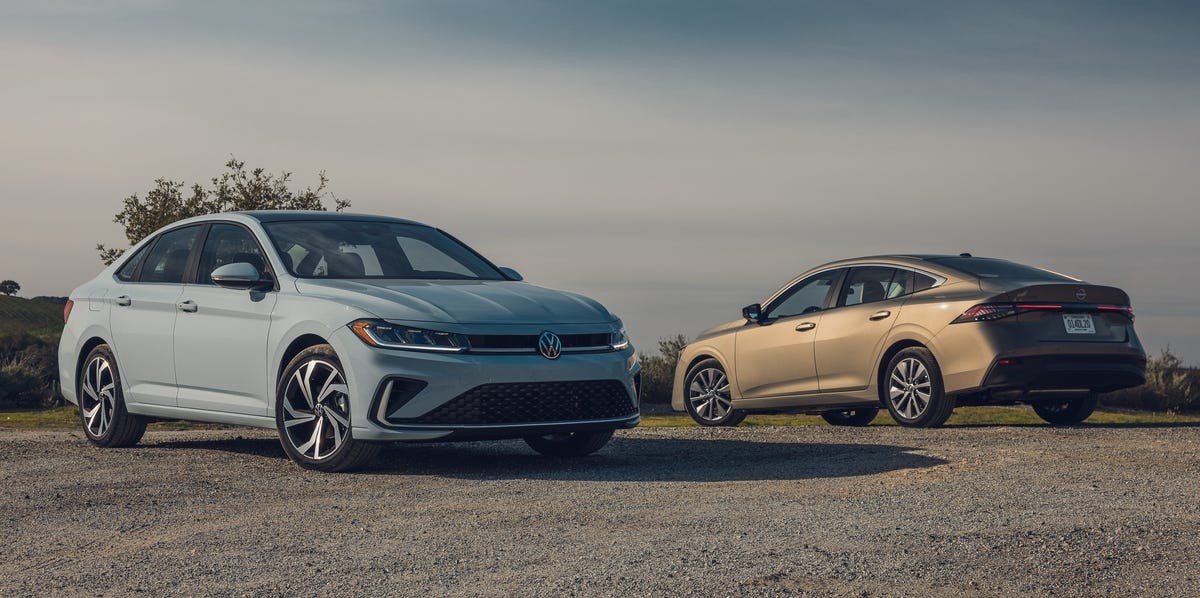
The American automotive market has shifted dramatically in recent years, with SUVs dominating sales as consumers prioritize space and perceived versatility. However, the compact sedan segment remains relevant for budget-conscious buyers who prefer efficiency and practicality. This test pits the redesigned 2026 Nissan Sentra SL against the established Volkswagen Jetta SEL to determine which offers the best value in a landscape increasingly dominated by crossovers. Both cars represent automakers’ continued investment in affordable vehicles despite shifting trends, proving there’s still demand for a good, no-frills sedan.
What We Tested: Trim Levels and Pricing
Both Nissan and Volkswagen offer entry-level models under $26,000, but this comparison focuses on the top-tier trims before performance variants (like the Jetta GLI) enter the picture. The Nissan Sentra SL starts at $29,235 and reached $30,375 with minimal options: floor mats, a trunk mat, ambient lighting, and a distinctive Imperial Bronze paint job. The Volkswagen Jetta SEL begins at $31,270, with the only upgrade being the Monument Gray exterior for a final price of $31,725.
Both vehicles include standard features like auto-dimming mirrors, sunroofs, dual-zone climate control, and power seats. Notably, the Jetta adds heated and ventilated front seats (with heated rear outboard positions) and rain-sensing wipers, while the Sentra counters with an eight-speaker Bose sound system.
Exterior and Interior: Design and Comfort
The Sentra’s exterior stands out with its fresh styling, featuring a bolder grille and aggressive LED headlights. This design language sets it apart in a segment often defined by conservative aesthetics. The Jetta, while handsome, adopts a more understated approach, maintaining its clean lines from the 2019 redesign. Despite being 3.2 inches longer, the Jetta doesn’t feel significantly larger inside. Both sedans comfortably accommodate four adults, with the Jetta offering slightly more rear legroom. Trunk space is identical at 14 cubic feet.
Inside, the Jetta impresses with a more upscale feel, boasting leather-wrapped seats and a solid build quality. The Sentra’s cabin has improved but feels less cohesive, with a mix of materials. Both cars include wireless Apple CarPlay and Android Auto, along with wireless charging pads, but the Jetta’s infotainment system feels dated compared to the Sentra’s newer 12.3-inch touchscreen (though Nissan’s implementation lacks physical buttons, which some may prefer).
Performance and Handling: Where They Differ
Under the hood, the Sentra uses a 2.0-liter four-cylinder producing 149 horsepower paired with a continuously variable transmission (CVT). The Jetta offers a turbocharged 1.5-liter four-cylinder with 158 horsepower and an eight-speed automatic. This difference translates to real-world performance: the Sentra takes 9.1 seconds to reach 60 mph, while the Jetta manages in 7.8 seconds. The Jetta also stops from 70 mph in 170 feet, 13 feet shorter than the Sentra.
Fuel economy is comparable, with both cars rated around 33 mpg combined. However, in real-world testing, the Jetta achieved 31 mpg to the Sentra’s 28 mpg. The Jetta’s handling is more engaging, with better body control and more direct steering. The Sentra leans more in corners, and its CVT feels hesitant. Both cars ride comfortably, but the Jetta is quieter at highway speeds.
The Verdict: Jetta Takes the Win
The 2026 Nissan Sentra SL represents a step forward in styling and interior comfort, but it falls short in driving dynamics and powertrain refinement. The Volkswagen Jetta SEL emerges as the superior choice, offering a more satisfying driving experience, a more upscale cabin, and better performance at a comparable price. While the Sentra may appeal to some with its bold design and lower starting price, the Jetta delivers a well-rounded package that proves more competitive in today’s market. The Jetta remains the smarter choice for buyers who value both affordability and driving pleasure.
The Jetta’s win underscores a simple truth: a compelling sedan can still thrive in an SUV-dominated world.