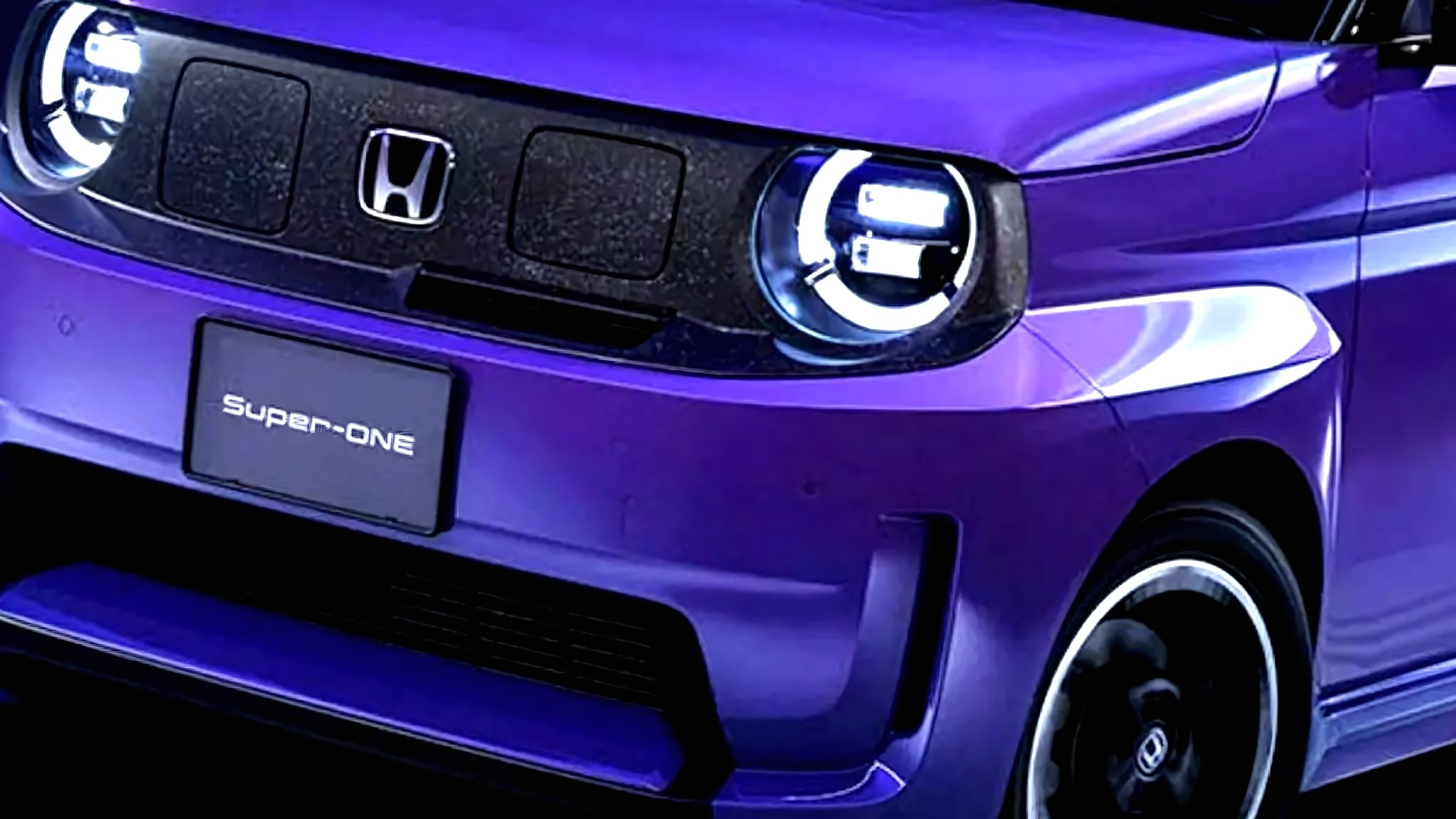
Honda is injecting a dose of retro spirit into the electric car market with the Super-One, a compact hot hatch designed to evoke the bold, analog energy of its 1980s predecessors. The vehicle, revealed in full after a teaser campaign, isn’t merely an electric upgrade; it’s a deliberate throwback to models like the City Turbo II Bulldog, blending modern EV technology with a distinctly rebellious aesthetic.
A Nod To The Past, Built For Today
The Super-One stands out with its aggressive styling: wider bodywork, functional air ducts, and blistered fenders give it a more muscular stance than the standard N-One e:. The car rides on new 15-inch alloy wheels, paired with wider Yokohama tires, and is available in a striking Boost Violet Pearl color alongside other options like Platinum White Pearl and Citron Yellow Pearl.
At 3,589 mm long, 1,573 mm wide, and 1,616 mm tall, the Super-One is noticeably larger than the N-One e:, though it retains the same wheelbase. The design isn’t about subtle improvements; it’s a clear statement that Honda is willing to stand out.
Inside The Retro-Electric Cockpit
The interior features reshaped seats with enhanced bolsters, purple accents, and a custom 7-inch digital instrument cluster. When activated, the Super-One’s Boost Mode transforms the display into a simulated tachometer, a playful nod to traditional gasoline engines.
Perhaps the most striking feature is the Active Sound Control system, which mimics gear shifts and engine growls through an eight-speaker Bose audio setup. While electric cars are known for their quiet operation, Honda is deliberately injecting artificial feedback to recapture the visceral experience of a combustion engine.
Performance And Specs
The Super-One is powered by a front-mounted electric motor. While official figures are pending, earlier reports suggest a Boost Mode output of 94 hp (70 kW / 95 PS), a significant increase over the N-One e:’s 63 hp.
The added power and wider dimensions mean the Super-One will be classified as a passenger vehicle rather than a kei car, marking a shift in Honda’s approach to compact EVs. The vehicle also boasts a custom chassis with lowered suspension and wider tracks for improved handling. Battery capacity and range figures remain undisclosed, though the N-One e: uses a 29.6 kWh unit.
Pricing And Availability
Honda is targeting a price range of ¥3,000,000 to ¥3,500,000 (approximately $19,700 to $22,900) for the Super-One, positioning it above the standard N-One e:. While full launch details are forthcoming, this price reflects the vehicle’s enhanced features and aggressive styling.
The Super-One is more than just an EV; it’s a deliberate attempt to inject personality and nostalgia into a segment often dominated by clinical efficiency. By embracing the spirit of its past, Honda is carving out a unique space for itself in the future of electric mobility.