In an era of rapid technological turnover, where smartphones and motorcycles are often obsolete within a few years, there is a growing segment of the market that prizes something different: longevity.
While many manufacturers race to add more screens, more sensors, and more complex electronics to their lineups, others—like Suzuki with the SV650 or Kawasaki with the KLR650—are content to keep perfecting a winning formula. Perhaps no model exemplifies this “if it isn’t broken, don’t fix it” philosophy better than the Kawasaki Vulcan 1700.
The Touring Philosophy: Reliability Over Gadgets
To understand why a 15-year-old design remains relevant, one must understand the core requirement of long-distance touring. Whether you are riding a high-performance sport tourer or a heavy-duty bagger, the primary goal of a tourer is to get you from Point A to Point B comfortably.
In the touring world, there is a hierarchy of needs:
1. Reliability: The most powerful engine is useless if it leaves you stranded 500 miles from the nearest service center.
2. Comfort: Long days in the saddle require ergonomic excellence.
3. Technology: Features like Bluetooth connectivity and advanced TFT displays are “nice-to-haves,” but they are secondary to the machine’s ability to perform.
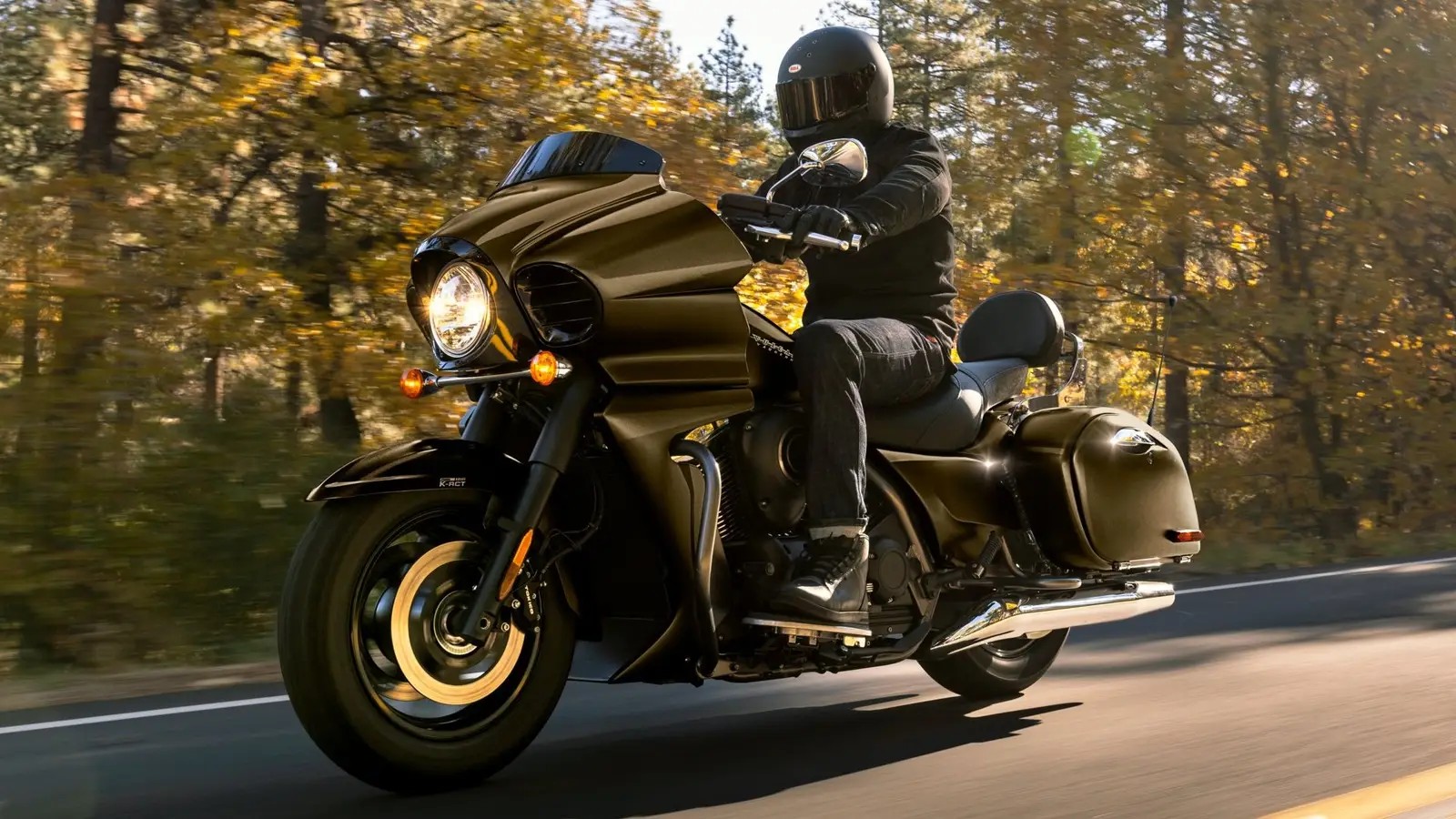
The Vulcan 1700, available in the Vanquero (a trunkless bagger) and Voyager (a full-dress tourer) configurations, prioritizes the first two above all else.
A Proven Powerplant: The Heart of the Vulcan
The centerpiece of the Vulcan 1700 is its massive 1,700cc liquid-cooled V-twin. Featuring a unique 52-degree cylinder layout, the engine is designed to provide a distinctive rumble and substantial low-end power.
- Torque-Driven Performance: It produces 107.6 lb-ft of torque starting from as low as 1,500 RPM. This means the bike feels effortless and “meaty” during highway cruising without requiring constant gear changes.
- Smooth Delivery: The inclusion of ride-by-wire technology helps smooth out throttle inputs, making a heavy machine feel much more manageable.
- Low Maintenance: Power is delivered via a carbon fiber belt drive, which is significantly more durable and requires far less upkeep than a traditional chain.
Because this platform has been refined since its introduction in 2009, Kawasaki has effectively “ironed out” the kinks. This is why it is common to see owners reporting six-digit mileages on these bikes, all while maintaining a standard 36-month factory warranty.
Simplicity as a Feature, Not a Flaw
Critics often point to the Vulcan 1700’s lack of cutting-edge tech as a weakness. However, in the context of long-distance travel, this simplicity is a strategic advantage.
The bike utilizes a traditional “riding triangle” of pullback handlebars, floorboards, and a generous saddle to ensure comfort. Its electronics are intentionally lean, consisting primarily of ABS (via Kawasaki’s Coactive-Braking Technology) and electronic cruise control.
By avoiding an overabundance of complex digital systems, the Vulcan 1700 minimizes the risk of “electrical gremlins”—those frustrating technical failures that can ruin a trip.
Unbeatable Value in a Premium Market
Perhaps the most compelling reason to consider the Vulcan 1700 in 2026 is its price point. As touring motorcycles become increasingly expensive, Kawasaki has positioned the Vulcan as a high-value alternative to both American and European heavyweights.
| Model | Approximate Starting Price | Key Competitors |
|---|---|---|
| Vulcan 1700 Vanquero | ~$19,999 | BMW R 18 B, Indian Challenger |
| Vulcan 1700 Voyager | ~$20,199 | BMW R 18 Transcontinental, Harley-Davidson models |
While the Honda Gold Wing or BMW K 1600 series may offer more sophisticated technology, they come at a significantly higher cost. The Vulcan 1700 provides the essentials—luggage, wind protection, and massive torque—at a fraction of the price.
Conclusion
The Kawasaki Vulcan 1700 is a masterclass in purposeful engineering. By focusing on a reliable powertrain, proven ergonomics, and mechanical simplicity, Kawasaki has created a machine that offers a distraction-free touring experience that remains highly relevant in an increasingly digital world.