Mazda’s reputation for high-performance vehicles has waned in recent years. While the MX-5 Miata remains a icon for driving purists, the brand’s broader performance legacy—anchored by the rotary-engine RX-7 and RX-8, as well as the turbocharged Mazdaspeed3 and 6—is largely dormant.
With the industry shifting toward electrification, a natural question arises: What would a modern, high-performance Mazda sedan look like?
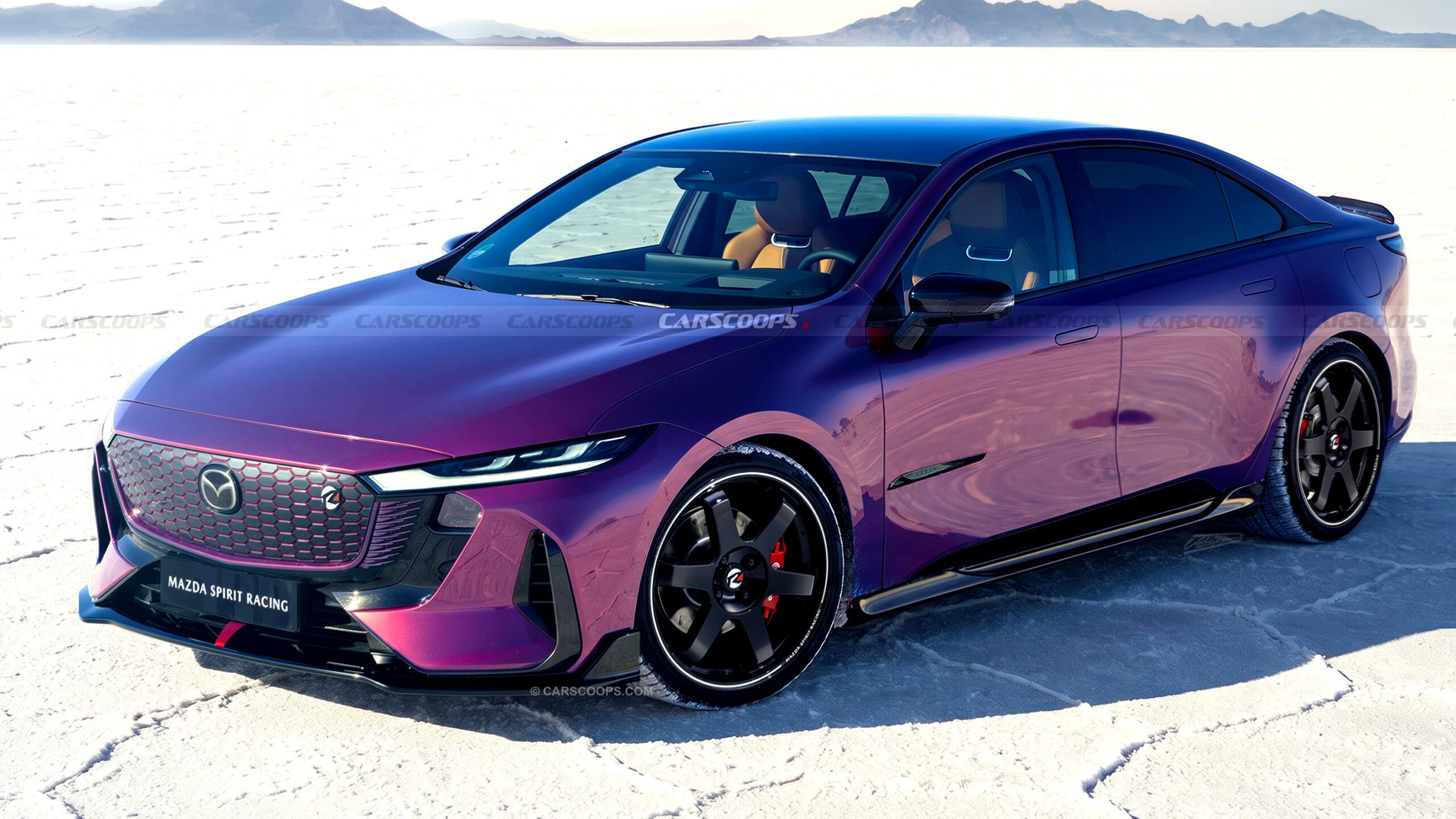
Although Mazda has not announced such a vehicle, we have conceptualized a hypothetical “Mazda Spirit Racing” (MSR) version of the upcoming all-electric Mazda 6e. This thought experiment explores how Mazda could leverage its new electric platform to reclaim its place in the performance segment, blending the brand’s signature design ethos with serious track-capable hardware.
Design: Subtle Aggression
The base Mazda 6e (also known as the EZ6 in some markets) is a reskinned version of the Deepal sedan, recently earning the 2026 World Car of the Year Design award. Rather than drastically altering this acclaimed silhouette, the MSR concept adopts a restrained but sharp aesthetic.
- Front End: The grille is closed off for aerodynamic efficiency, featuring a red-accented honeycomb pattern. The bumper is reworked with deeper corner intakes and a pronounced splitter to enhance front-end downforce and handling stability.
- Profile: The stance is lowered and widened. “Pumped” wheel arches house larger, dark-finish alloy wheels wrapped in Michelin Pilot Sport 5 tires. Sculpted side skirts add visual aggression without compromising airflow.
- Rear: A larger deployable spoiler, smoked taillights, and a functional-looking diffuser complete the aggressive rear profile.
Interior: Sport Luxury Over Pure Racing
While the exterior hints at track readiness, the interior prioritizes “sport luxury.” The cabin upgrades focus on driver engagement and material quality:
- Seats: Nappa leather seats feature deeper bolstering and RS-style honeycomb inserts for improved lateral support.
- Controls: Addressing customer feedback regarding the standard model’s heavy reliance on touchscreen inputs, the MSR concept reintroduces physical controls at the base of the infotainment display.
- Driver Experience: A thick-rim steering wheel, alloy pedals, and unique graphics reinforce the performance brief. The user interface includes performance telemetry and driver-configurable drive modes.
Chassis: Transforming Handling Dynamics
The standard European-spec Mazda 6e utilizes a rear-drive setup derived from Changan. Critics have noted its handling as uninspiring and its performance as middling. The MSR concept aims to rectify this through significant mechanical upgrades:
- Suspension & Steering: Stiffer bushings, a lower ride height, and recalibrated electric power steering would sharpen response. Adaptive damping and thicker anti-roll bars would reduce body roll.
- Braking: Larger brake discs paired with 8-piston calipers would provide the stopping power necessary for high-speed performance.
- Torque Vectoring: Beyond Mazda’s existing G-Vectoring Control software, the MSR would utilize electric motor torque vectoring to improve turn-in precision and exit speeds.
Drive Modes:
Variable drive modes would range from comfort to track. The track mode would feature aggressive regenerative braking mapping, simulated gear shifts, a “boost” mode for instant power, and a stability control system that allows controlled rear-end slip to aid rotation.
Powertrain: Dual-Motor Performance
Unlike the rear-wheel-drive donor car, the hypothetical MSR 6e would be a dual-motor all-wheel-drive vehicle.
- Output: Up to 536 horsepower (400 kW).
- Acceleration: Realistically, the 0–60 mph (0–96 km/h) sprint would be completed in the low 3-second range.
- Battery & Range: The vehicle would retain the standard 78 kWh Lithium Iron Phosphate (LFP) battery. This provides a WLTP-rated range of up to 430 miles (550 km).
- Charging: DC fast charging would allow for a 10–80% charge in approximately 24 minutes.
Market Context: Who Is the Rival?
If realized, the Mazda Spirit Racing 6e would not compete with hypercars like the upcoming BMW iM3. Instead, it would target the premium performance EV sedan segment, directly challenging:
- Tesla Model 3 Performance
- Hyundai Ioniq 6 N
- Polestar 2
- BYD Seal Performance
- MG IM5 Performance
Conclusion: While the Mazda Spirit Racing 6e remains a conceptual exploration, it highlights a viable path for Mazda to reintroduce performance into its lineup. By combining the 6e’s efficient electric platform with serious chassis upgrades and dual-motor power, Mazda could offer a compelling alternative to established EV performance rivals, bridging the gap between its historic Mazdaspeed legacy and its electric future.