Kia’s Telluride SUV earned critical acclaim for its combination of space, refinement, and value. The redesigned 2027 model, tested recently, builds on that foundation – but with some notable changes. The goal was clear: deliver a sequel that lives up to the original’s reputation, avoiding the pitfalls of disappointing follow-ups. Initial results suggest Kia has succeeded, though not without trade-offs.
What’s New? Bigger, Stronger, But Different
The second-generation Telluride has grown in size. The wheelbase is 2.7 inches longer, and the overall length extends by 2.3 inches. This translates into more usable space for passengers and cargo. While the third row holds one less carry-on box compared to the previous model, the second row fits one more, and with rear seats stowed, total cargo capacity increases by three boxes.
The cabin offers marginally more headroom and legroom throughout. Six-footers will find ample space in the middle row, whether equipped with captain’s chairs or a three-across bench. The rear seats are now heated on hybrid trims, a welcome addition for passengers.
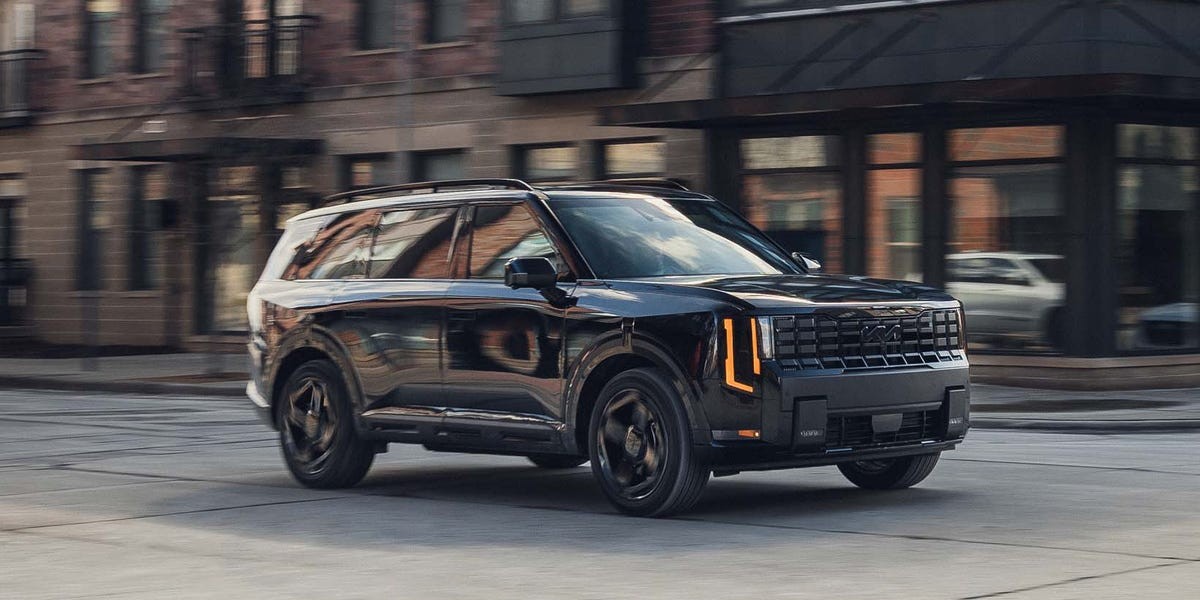
Stylistically, the new Telluride borrows cues from Kia’s EV9 electric SUV: chiseled lines, bolder LED running lights, and available 21-inch wheels. Inside, the design is more minimalist. While materials remain high-quality, some reviewers note a loss of the previous model’s luxury feel.
Engine and Performance: A Trade-off for Efficiency
The biggest mechanical change is the optional 329-hp hybrid powertrain. However, the standard engine is a turbocharged 2.5-liter four-cylinder making 274 horsepower and 311 lb-ft of torque. This is a decrease of 17 hp compared to the outgoing 3.8-liter V6, but an increase of 49 lb-ft in torque.
Testing revealed the new model is slightly slower to 60 mph (7.4 seconds) than the previous Telluride (6.7 seconds), despite being heavier. The new engine prioritizes low-end torque for everyday driving, but doesn’t match the old V6’s outright acceleration.
Fuel economy is rated at 20 mpg combined, mirroring the non-hybrid Palisade. Hybrid models achieve 35 mpg. Cabin noise has been slightly reduced to 66 decibels at 70 mph.
Ride and Handling: Refined, But Not Sporty
The Telluride continues to prioritize comfort over sportiness. The suspension effectively absorbs road imperfections, even with larger wheels. Steering is precise for a family SUV thanks to the relocation of the power steering motor. Braking performance remains solid, with a 70-to-0 mph stopping distance of 170 feet.
Pricing and Verdict
The base price has increased by nearly $3,000, starting at $40,735 for a front-drive LX model. The top-spec X-Line SX Prestige AWD model tested costs $56,435. The hybrid powertrain adds $2,700 but is not available on all trims.
The verdict: The 2027 Kia Telluride is a solid evolution of an already strong platform. It retains the key qualities that made the original successful—spaciousness, comfort, and value—while introducing subtle improvements. The engine trade-off may disappoint some, but the overall package remains compelling.
The Telluride stands apart from its corporate sibling, the Hyundai Palisade, with a more rugged aesthetic and a more potent base engine. Both vehicles are excellent choices, but the Telluride’s identity is now more clearly defined.