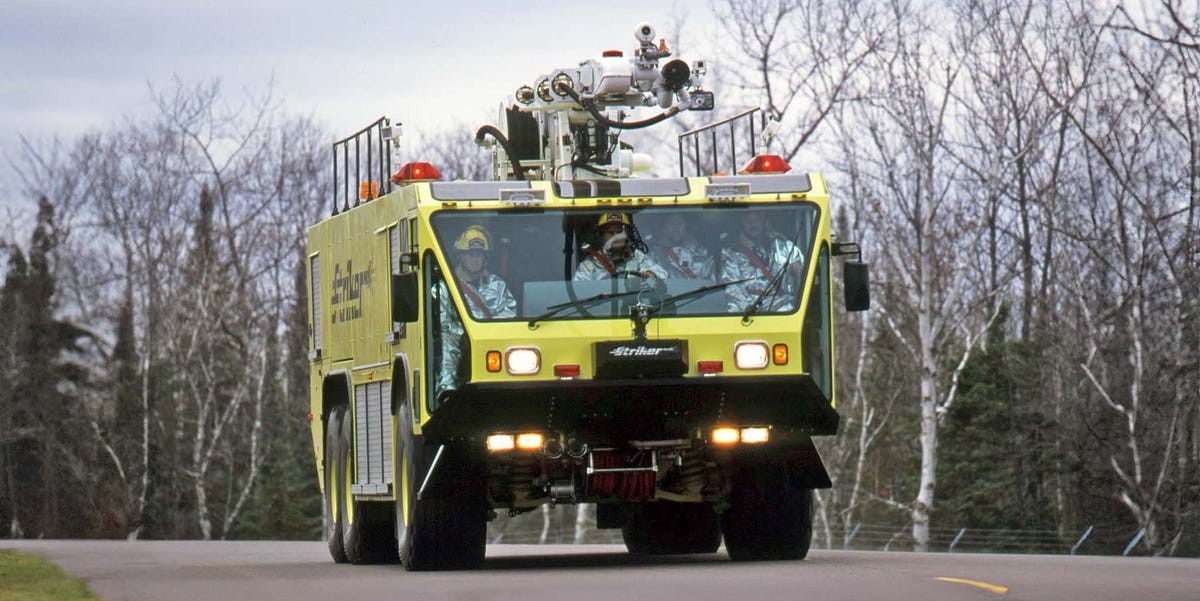
In 2002, Car and Driver took an unusual test drive: the Oshkosh Striker 3000, a $675,000 aircraft rescue fire fighting (ARFF) truck designed for the worst-case scenarios at airports worldwide. This isn’t just a firetruck; it’s a six-wheeled, 40-ton machine built to survive and suppress fires around crashed airplanes, often in conditions that would destroy lesser vehicles.
Built for Extreme Conditions
The Striker’s design isn’t about speed in the traditional sense – though it can reach 50 mph in 35 seconds, as required by the FAA. It’s about relentless capability. Its six-wheel drive, combined with a 30-degree approach/departure angle and the ability to climb a 50% grade, means it doesn’t just follow roads; it makes its own path through debris fields, fences, and even trees. At 10 feet wide, the Striker is built to maintain stability even when leaning at a 30-degree angle.
This extreme durability isn’t accidental. ARFF training centers, like the one at Lake Superior College in Duluth, Minnesota, simulate disasters using actual aircraft wreckage: DC-10s, Cessnas, helicopters, and mobile homes set alight for practice. The Striker’s job isn’t just to put out fires; it’s to operate in the chaos created by them.
Engineering for Survival
The truck’s 650-horsepower Caterpillar in-line six engine delivers 1950 lb-ft of torque, enough to flatten obstacles rather than avoid them. A rear-mounted engine with a massive roof radiator prevents overheating even in extreme temperatures, ensuring continuous operation during prolonged incidents.
The Striker’s payload includes a 3000-gallon water tank and 420 gallons of aqueous film-forming foam (essentially heavy-duty dish soap) for smothering fuel fires. Three spray guns – a 1200-gpm roof turret, a 300-gpm bumper turret, and a 250-gpm piercing nozzle – can drain the main reservoir in under two minutes, requiring support from “nurse trucks” for refills.
The Tools of the Trade: From Snozzles to Piercing Nozzles
A key feature is the Snozzle, a cherry picker with a 50-foot reach and an infrared camera that can see through smoke, identify hot spots, and even detect whether a plane has just landed by monitoring tire heat. However, the most brutal tool is the $10,000 piercing nozzle: a 44-inch carbon steel lance capable of punching through aircraft fuselages, railway tankers, and even masonry.
Operators are trained to aim for 12 inches above passenger windows, though “if you can’t find the top of the fuselage…well, you just hope no one’s in the way.” This blunt practicality underscores the grim reality of ARFF work: prioritizing containment over niceties in life-or-death situations.
Designed for the Unthinkable
The Striker’s cockpit, with its expansive glass view, provides situational awareness during intense radio communication with dispatchers, control towers, and even the aircraft’s pilot. Drivers can engage undercarriage sprinklers to prevent tire burnout, drop tire pressures for off-road maneuverability, and activate a deluge system to cool the windshield.
Airport firefighters may go years without a major incident, but the Striker ensures they’re prepared for anything: from fuel fires to downed planes, even assisting municipal firefighters at disasters like the Pentagon attack, where Oshkosh trucks pumped foam extinguishant for five straight hours.
The Oshkosh Striker 3000 isn’t just a firetruck. It’s a rolling fortress built for the most catastrophic events imaginable, a testament to the brutal efficiency required when facing down disaster.