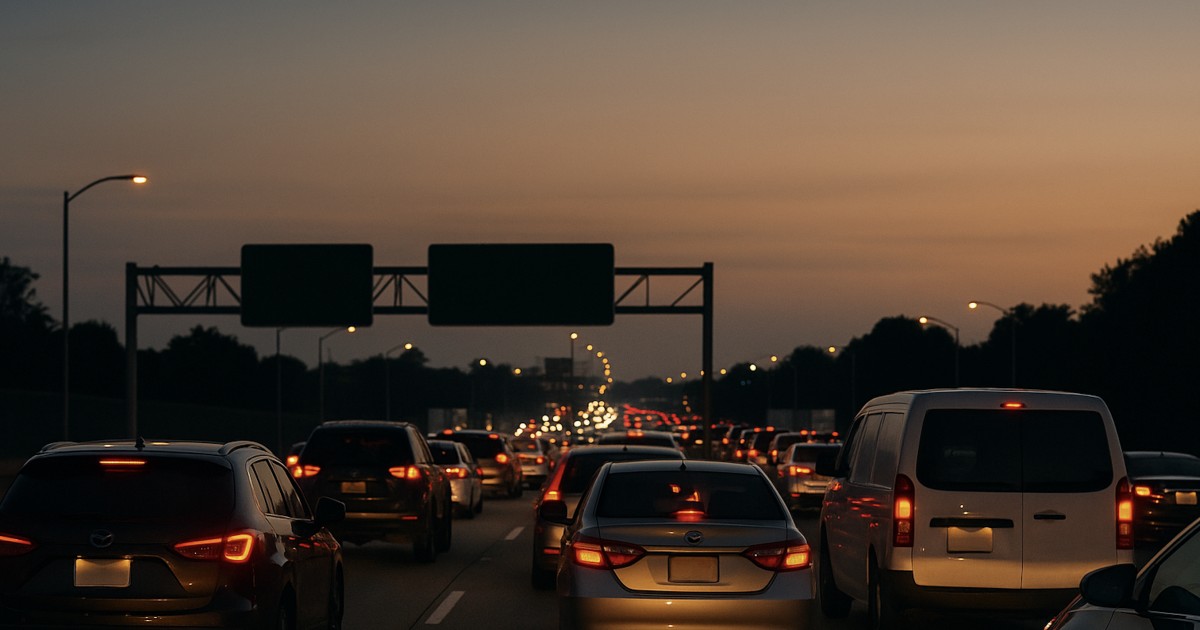
Congestion in Australia’s major cities costs drivers over $10 billion each year in lost time and fuel, according to a new analysis of commute patterns. The study, based on real-world traffic data, census information, and economic factors, reveals a significant financial and temporal burden on full-time workers who rely on driving.
The National Toll: $10.1 Billion Lost Each Year
Across the 11 largest Australian cities, drivers collectively lose approximately 212 million hours annually stuck in traffic, burning an extra $462 million in fuel. Factoring in the opportunity cost of this wasted time – the potential earnings or productivity lost due to congestion – brings the total economic impact to $9.7 billion, pushing the overall cost to drivers beyond $10.1 billion annually.
This is not just about wasted fuel; it’s about lost productivity, delayed meetings, and a measurable drag on the national economy. The issue is worsening as city populations grow and infrastructure struggles to keep pace.
Melbourne and Sydney: The Most Expensive Cities to Drive In
Melbourne emerges as the most expensive city for drivers, with an average annual congestion cost of $4628 per full-time worker. This breaks down to roughly $4457 in lost time and $171 in extra fuel, totaling 3 days, 22 hours, and 5 minutes wasted in traffic each year.
Sydney is a close second, costing drivers $4568 annually, with 4 days and 25 minutes spent in congestion. Though Sydney drivers lose slightly more time overall, the financial impact is nearly identical to Melbourne’s.
Perth, Brisbane, and Adelaide round out the top five cities, with congestion costs exceeding $3300 per year. Darwin, by contrast, has the least costly congestion at $1390 annually.
CBD Congestion: Adelaide Takes the Lead
When focusing on inner-city traffic, Adelaide experiences the slowest rush-hour delays. A typical 20km round trip through the city center takes an extra 22 minutes and 10 seconds each day due to congestion, adding up to roughly 3 days and 13 hours of wasted time annually. Melbourne’s city center is only marginally better, with drivers losing 21 minutes and 55 seconds per day.
The Impact Varies by Occupation
The study highlights that the burden of congestion isn’t spread evenly. Stationary plant operators lose the most time, averaging 4 days, 10 hours, and 7 minutes per year stuck in traffic.
However, medical practitioners face the highest dollar cost, with congestion costing them an average of $6784 annually due to their high hourly wages. Other professions heavily affected include air and marine transport professionals, health diagnostics workers, ICT managers, and advertising/PR executives. For these roles, traffic effectively acts as unpaid overtime.
Data and Methodology
The analysis used data from the Australian Bureau of Statistics (ABS) 2021 Census, ABS Characteristics of Employment 2024, TomTom traffic data, petrol prices from the ACCC’s June 2025 report, real-world fuel consumption figures, and vehicle mix data. This rigorous methodology ensures accurate and reliable estimates of congestion costs across Australia.
In conclusion, traffic congestion represents a substantial economic and personal burden on Australian drivers. The high costs in Melbourne and Sydney, coupled with the varying impacts across different occupations, underscore the need for improved infrastructure, transportation alternatives, and urban planning to mitigate this growing problem.