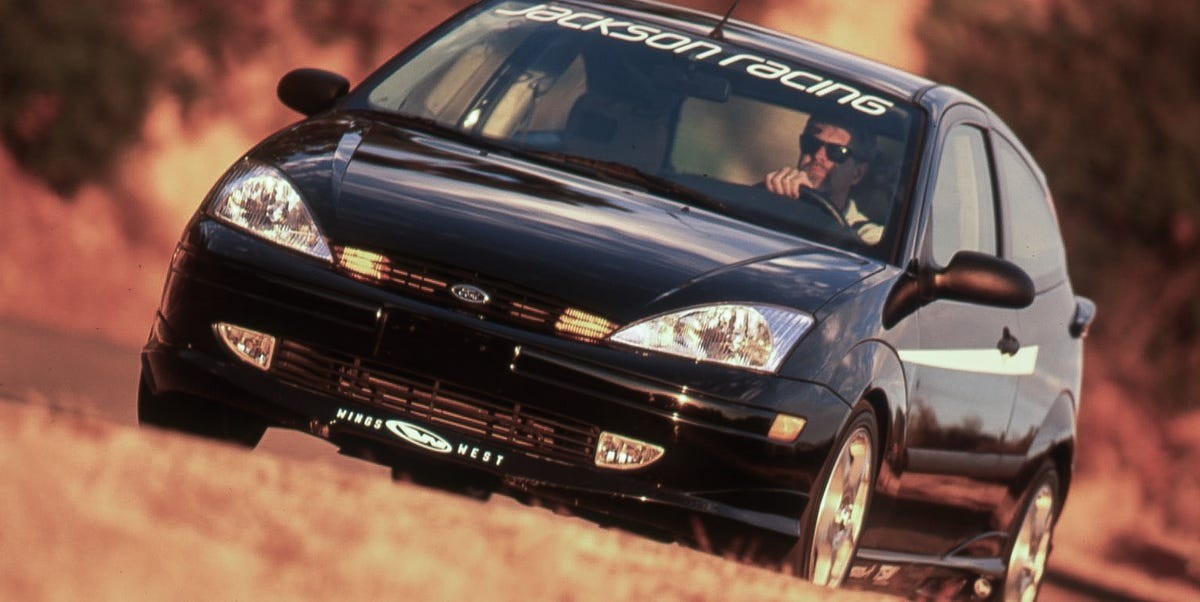
When evaluating modified vehicles, there is often an unwritten rule in automotive journalism: the value of a tuner car decreases as the size of its support crew increases. A car requiring four mechanics to function is effectively undrivable; one needing no assistance is inherently more reliable. In April 2002, Car and Driver tested a Ford Focus ZX3 modified by Jackson Racing, a kit that arrived with zero attendants. This absence of logistical baggage set the stage for a test that prioritized daily usability over raw, uncompromising speed.
The Philosophy Behind the Power
Oscar Jackson, founder of Jackson Racing, represents a different generation of automotive tuners. At 47 years old at the time of the test, his approach contrasts sharply with the “nihilistic bombast” often associated with teenage car enthusiasts. While many tuners chase extreme modifications, Jackson’s goal was maturity: enhancing performance for daily driving rather than creating a hyperactive racing machine.
The centerpiece of this modification is an Eaton Roots-type supercharger. This same technology is found in high-end vehicles like the Mercedes SLK230 and the Jaguar XJR, lending credibility to the kit. For the Ford Focus ZX3, Jackson installs the smallest 45-cubic-inch version of the twin-rotor blower onto the stock 2.0-liter Zetec four-cylinder engine.
Key technical details include:
* Boost Pressure: The supercharger spins at 1.73 times the engine speed, utilizing an integral bypass valve to maintain a modest 6.0 pounds of boost.
* Integration: The unit breathes through the stock throttle body and air filter, blowing into a specially cast manifold.
* Supporting Mods: The build includes Focus Sport “shorty” headers and a stainless steel exhaust system.
Visually, the installation is nearly invisible. Aside from a supplemental electronic fuel controller strapped to the battery cover, the engine bay appears as if it were assembled by Ford itself. This attention to detail underscores Jackson’s intent: seamless integration.
On-Dyno Performance: Gains and Limitations
To understand the real-world impact, it is necessary to look at the dynamometer results. Jackson Racing tested a stock Focus ZX3 on their Dynojet chassis dynamometer, recording 103.4 horsepower and 110.7 pound-feet of torque at the wheels. (Note: Ford’s official claims were higher, citing 130 hp and 135 lb-ft at the flywheel.)
With the supercharger kit installed, the figures improved significantly:
* Horsepower: Increased to 150.2 hp (a gain of ~47 hp).
* Torque: Rose to 129.5 lb-ft.
* Power Band: The peak power shifted from Ford’s claimed 5,300 rpm to near the engine’s 7,000-rpm redline.
However, the distribution of this power reveals a critical limitation. The supercharger excels at improving top-end power but offers minimal benefit at the lower end of the rev range. Consequently, while the car feels more alive at high speeds, the initial “grunt” required for low-speed acceleration remains largely unchanged.
Real-World Driving Dynamics
The dyno numbers translate to measurable improvements in acceleration, though not as dramatically as one might expect from a 47-horsepower gain in a lightweight vehicle. The test car, equipped with shorter-diameter Yokohama A520 tires, posted the following times:
- 0–60 mph: 8.4 seconds (Stock: 9.1 seconds)
- Quarter Mile: 16.6 seconds at 84 mph (Stock: 16.9 seconds at 81 mph)
- 30–50 mph: 11.1 seconds (Stock: 15.0 seconds)
- 50–70 mph: 12.7 seconds (Stock: 13.8 seconds)
Key Insight: The most significant improvement was in mid-range acceleration (30–50 mph), where the car shaved nearly four seconds off the stock time. However, the 0–30 mph time remained identical at 2.7 seconds, confirming that the supercharger does not aid initial launch.
Despite these gains, the modified Focus still trailed Ford’s own SVT Focus. The factory SVT model, with 170 horsepower and a six-speed transmission, reached 60 mph in 7.8 seconds and completed the quarter-mile in 16.1 seconds at 87 mph. The Jackson kit, while effective, could not bridge the gap to the purpose-built performance variant.
Ride Quality and Refinement
One of the standout features of the Jackson Racing kit is its refinement. Unlike many aftermarket superchargers that introduce throttle lag, noise, or rough idling, this system was nearly silent. The bypass valve produced only a slight “whoosh” during throttle changes, and the engine started and ran without hesitation.
The test car also featured suspension upgrades, including sport springs, Koni adjustable shocks, and TSW wheels. While these modifications lowered the car by 1.25 inches and improved handling balance, they also reduced compliance. The ride became firmer, lacking the refined capability of the SVT Focus, which utilized larger 17-inch wheels and a more sophisticated chassis setup.
The Verdict: Is It Worth the Investment?
The final calculation comes down to cost versus performance. The Jackson Racing supercharger system retails for $3,295. When adding the necessary headers, exhaust, suspension components, wheels, and body kit, the total investment exceeds $7,000 —excluding installation costs.
In comparison, the base price of the factory SVT Focus was $17,995. While the SVT is more expensive upfront, it delivers superior performance, better ride quality, and factory warranty coverage. For a buyer seeking the ultimate focus experience, the SVT remains the undeniable bargain.
However, the Jackson kit serves a different purpose. It offers a reliable, refined, and visually subtle way to enhance the daily driving experience of a standard Focus ZX3. It is not a race car, but a mature modification for enthusiasts who value usability and integration over absolute speed.
Conclusion: The Jackson Racing supercharger proves that thoughtful tuning can enhance a stock vehicle without sacrificing reliability or comfort. While it cannot compete with the factory SVT model in raw performance, it offers a compelling, refined upgrade for those who prefer a balanced, daily-drivable modification over extreme power gains.