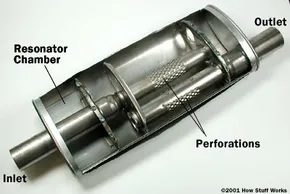
It looks like a simple steel can attached to the exhaust pipe of your car. But inside this box is a carefully constructed labyrinth designed to do just one thing: eliminate noise.
There are no moving parts. Just a series of tubes, chambers and holes. The goal is acoustic interference. Sound waves are trapped, reflected back and forced to collide with other waves until they cancel each other out. It’s physics used to annoyance reduction.
Path of least resistance
When the exhaust gases and the accompanying sound waves enter the muffler, they start at the center pipe. This is the primary channel. The gas hits the back wall of the muffler and has to be redirected.
It doesn’t just flow out. It is pressed through a special hole in the main body of the muffler. From there it passes through a series of perforations into the second chamber. The gas rotates, moves through the internal geometry and finally exits through the final tube.
The flow is continuous. The noise is not.
The role of the resonator
A resonator is embedded in this system. The connection to the first chamber is through one hole. Think of it as a separate noise reduction zone.
The resonator contains a certain amount of air. Its length is not arbitrary. It is calculated that a sound wave is generated that is the exact opposite of the problematic frequency. When an unwanted wave hits the wave in the resonator, they interfere. Destructive interference occur. The amplitude decreases. The sound disappears.
How does this exact cancellation work at the molecular level? The air in the resonator vibrates at a natural frequency. When an exhaust pulse of the same frequency arrives, the resonator absorbs energy. It works like a sponge for sound.
Why this is important
Without this design, your car would sound like a dying tractor. The resonator targets certain low-frequency sounds that irritate the human ear the most. It doesn’t silence everything. It adjusts the exhaust sound.
The rest of the muffler covers a wider spectrum. Chambers and baffles create back pressure. This slows the gas down. Slower throttle means less turbulence. Less turbulence means less noise.
But the resonator is a scalpel. The rest of the muffler is the hammer.
You might wonder why manufacturers don’t just pack the whole box in fiberglass. They used to. Modern designs are more complex. They ensure a balance between noise reduction and flow efficiency. A clogged muffler affects performance. A well-designed one preserves horsepower and keeps decibel levels low.
The air in this pipe is working overtime. Every hole, every chamber, every bend is a calculation. Miss the length by one millimeter, the cancellation will fail. The wave doesn’t cancel. It amplifies.
That is the difference between a smooth idle and a headache-inducing drone.