


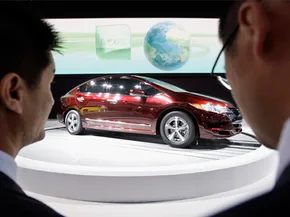
You can’t buy a hydrogen car yet. If you live in California, however, you can lease one. It doesn’t sip gasoline. It doesn’t pollute the air. The exhaust is just steam. The mystery fuel is hydrogen. This is the simplest, most abundant element in the universe. Some experts think we will all be driving these fuel-efficient vehicles in 20 to 30 years.
The idea isn’t new. The technology for using hydrogen to generate power dates back to the first part of the 19th century. That is older than the automobile itself. What is new is seeing a hydrogen-powered car on the road. Steam coming from the exhaust pipe instead of foul-smelling gases. Several hydrogen cars exist today. Most are concept cars. These eco-friendly driving machines include the Chevrolet Equinox. The BMW 745h is another example. The Honda FCX is the one currently available for lease in California.
What makes a hydrogen car possible is a fuel cell. It converts hydrogen to electricity. The only byproducts are heat and water. Because it is non-polluting, hydrogen seems like the ideal fuel for the 21st century. A lot of people in the government and the auto industry are excited about its potential. Hydrogen cars have the potential to be fuel-efficient. They offer the hope of eco-friendly, green driving.
“Unless you happen to live in very specific parts of the country and have pockets lined with cash, don’t expect a hydrogen car in your driveway within the next decade.”
There are still a lot of problems that need to be overcome. Questions need to be answered before hydrogen becomes the fuel of choice. It needs to make much difference in our current use of fossil fuels. For instance, where will we get the hydrogen? How expensive will these fuel-efficient cars be to purchase? Will you be able to find a hydrogen fuelling station to refill your tank? And perhaps most importantly, as a fuel, is hydrogen really as non-polluting as it seems?
We will look at those questions in the pages that follow. But we can give you one quick answer right now. Unless you happen to live in very specific parts of the country and have pockets lined with cash, don’t expect a hydrogen car in your driveway within the next decade.
Hydrogen Fuel Cells

Sir William Robert Grove didn’t just invent a gadget. He reversed physics. In 1839, the Welsh scientist took electrolysis—the process of using electricity to split water into hydrogen—and flipped it. He created electricity and water from hydrogen. He called it a gas voltaic battery. We call it a hydrogen fuel cell.
Decades later, Francis Bacon refined the tech. This invention is the heart of the modern hydrogen vehicle.
From Space Capsules to City Streets
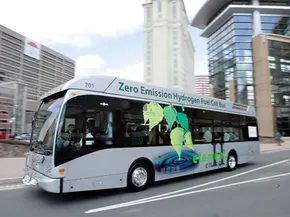
General Electric built the first practical system in the early 1960s. It powered orbital space capsules. By the 1990s, fuel cells were running city buses. Feasibility wasn’t a guess. It was proven.
Think of a fuel cell as a battery with an ego problem. A battery holds its fuel inside. A fuel cell needs to be refilled. Its fuel is hydrogen. It is the simplest element. One electron. One proton.
The cell generates power by stripping electrons from protons. Those electrons flow as a pure current. The ionized hydrogen atoms meet oxygen. They form water. Heat is the other byproduct. That water usually exits as steam.
Zero tailpipe emissions. You drive, you exhale steam.
The Mechanics of PEM
Cars use a specific type of cell. The polymer exchange membrane fuel cell. It’s light. It’s small.
It has two electrodes. A negatively charged anode. A positively charged cathode. A catalyst. And a membrane.
Hydrogen enters as H2 molecules. Two hydrogen atoms shackled together. The catalyst at the anode breaks the bond. You get hydrogen ions (protons) and electrons. The ions pass through the membrane. The electrons cannot. They have to go around.
That detour is the power. You harness that flow to do work.
Oxygen enters at the cathode. The protons and electrons reunite there. They join with oxygen. Water forms. Most of it becomes exhaust.
The cells are flat. Thin. They stack. More cells in the stack mean higher voltage. Simple math.
The Freedom Fuel Initiative
Many assumed fuel-efficient vehicles like hydrogen-powered cars were the answer to 21st-century energy demands. In 2003, President George W. Bush signaled this belief. He announced a $1.2 billion Freedom Fuel Initiative.
The goal? Support fuel cell development.
There are two main advantages over fossil fuels. First, oil isn’t depleted. We preserve existing supplies. We reduce dependency on foreign oil.
Second, pollution drops to zero. The only byproducts are heat and water. Carbon emissions from cars are linked to global warming. Fuel cells don’t add to that pile.
On the next page, we’ll look at production. How these cars are built. And more importantly, where the hydrogen comes from.


Manufacturing a hydrogen car isn’t rocket science. It’s barely different from building a standard internal combustion engine vehicle. The drivetrain and electrical architecture take the hit, of course. A fuel cell stack generates electricity rather than burning gas. That means the powertrain shares more DNA with a battery-electric vehicle than a traditional sedan.
The real bottleneck isn’t assembly lines. It’s the fuel itself.
Hydrogen is the universe’s most plentiful element. It makes up about 90 percent of all atoms. You’d think extracting it would be trivial. Think again. It’s also the lightest element in existence. Any free hydrogen on Earth’s surface doesn’t stay put. It floats away into outer space. What’s left on the planet is locked up. Most commonly in water molecules (H2O). Water covers the surface of this planet. A lot of it.
So, how do we split those H2O molecules? Or do we look elsewhere for a source?
The Electrolysis Method
The simplest path dates back over 150 years to Sir William Grove. Electrolysis. Pass an electric current through water and the H2O molecules break apart. The process mirrors a fuel cell in reverse. It uses an anode and a cathode, typically made from inert metals.
When the current hits the water:
– Hydrogen gathers at the cathode.
– Oxygen gathers at the anode.
It’s slow. But it scales. You can do this on an industrial level. It’s clean if the electricity is clean.
The Natural Gas Shortcut
There’s another way. Natural gas. It’s full of hydrocarbons. Steam reformation pulls hydrogen out of that gas and leaves the carbon behind. This is currently the dominant method for industrial-scale hydrogen production. It will likely be the first method used to fuel the initial wave of fuel-cell vehicles.
Here’s the catch. Steam reformation relies on fossil fuels. If the goal is to stop burning fossil fuels, using natural gas to make hydrogen is ironic. It’s arguably the worst possible source for a “green” fuel.
Garage-Sized Plants and Water-Powered Cars
Some experts dream of miniature hydrogen plants. Ones that fit in your garage. You wouldn’t need to visit a fueling station. You’d just fill up at home.
The extreme end of this idea suggests doing electrolysis inside the car itself. A car that runs on water. It sounds like science fiction. But it requires power. The electricity for electrolysis has to come from somewhere. A battery. So, a water-powered car would still need periodic recharging. It’s not a perpetual motion machine. It’s just moving the energy source from a gas station pump to a wall outlet.
The Road Ahead
Are these green driving machines the future? Many hope so. But the path to a hydrogen-powered world is littered with potential roadblocks. Production costs. Infrastructure gaps. Efficiency losses.
We’ll look at those setbacks next.
Hydrogen Car Setbacks
You still hear the hype. Hydrogen fuel cells are often painted as the holy grail of clean transport. It sounds clean. It sounds efficient. It sounds like the future. But the reality is messier. We are decades away from seeing these vehicles dominate the roads. The hurdles are not just technical. They are economic, logistical, and frankly, a bit embarrassing for the proponents of the technology.
We can break the setbacks into three buckets. The first is money. A lot of it. The second is the physics of storing a gas that refuses to stay put. And the third is the uncomfortable truth about where that hydrogen actually comes from.
The infrastructure nightmare and price tag
Let’s talk dollars. If you bought a hydrogen vehicle today, you would have nowhere to put fuel in it.
Refueling infrastructure is practically nonexistent. California is the exception. Governor Arnold Schwarzenegger pushed hard for this back in the day, so you’ll find stations there. Elsewhere? Try finding a dispenser. It’s like looking for a needle in a haystack.
Building that network isn’t cheap. Pessimistic estimates peg the cost of a nationwide infrastructure at $500 billion. And that’s not a weekend project. It could take four decades to get it right.
Then there is the car itself.
Fuel cells rely on platinum as a catalyst. Platinum is expensive. Very expensive. A single vehicle costs more than $100,000. Some estimates go even higher. That is why you do not buy them. You lease them. And only in select markets. The average buyer cannot afford this.
Researchers are hunting for cheaper catalysts. We know they exist in labs. Nobody knows when they will scale up for mass production. Until then, the price tag remains a barrier.
The storage physics problem
Hydrogen is a gas. It expands. It wants to fill every available cubic inch. Compressing it into a tank for a car is an engineering headache.
But there is a thermal issue most people miss. When hydrogen sits in a tank on a parked car, it warms up. The gas expands. The pressure builds. The tank has to vent excess hydrogen to prevent rupture.
Leave the car sitting for a few days? You might find the tank empty. All that fuel leaked out because the physics of thermal expansion forced it to escape. That is not just inefficient. It is a safety hazard.
Hydrogen is highly flammable. Remember the Hindenburg disaster in the 1930s? That explosion was likely a hydrogen fire. It is a valid fear.
There is a silver lining, though. Hydrogen fires burn cooler than gasoline fires. They are less likely to trigger secondary explosions. And because hydrogen is lighter than air, it rises. If it escapes, it floats away quickly. It does not pool on the ground like gasoline. So, the risk of a ground-level explosion is lower. But the danger of a leak remains a persistent engineering challenge.
The pollution paradox
Here is the kicker. Is hydrogen truly non-polluting?
The tailpipe says yes. The only emissions from a fuel cell are heat and water. Clean. Pure. Beautiful.
But look at the source. The hydrogen has to be made somewhere.
Most hydrogen comes from natural gas. This process, called steam methane reforming, releases carbon dioxide. We are using a fossil fuel to create a “clean” fuel. It defeats the purpose.
Then there is electrolysis. Splitting water molecules using electricity. If that electricity comes from a coal-fired power plant, you are just shifting pollution from the car to the power grid. You are not eliminating it. You are just moving it.
The lifecycle emissions matter. If the energy to produce the fuel is dirty, the fuel is dirty.
The hybrid alternative
Optimists say we will solve these problems. They say the infrastructure will come. The costs will drop. The storage will stabilize.
But the timeline is long. Decades, not years.
In the meantime, we have better options for immediate efficiency. Hybrid electric vehicles are here now. They work. They are affordable. You can buy them today.
The Toyota Prius. The Ford Fusion Hybrid. These cars do not require a new infrastructure. They do not rely on rare metals like platinum at prohibitive prices. They do not leak fuel into the atmosphere because of thermal expansion.
For now, hybrids are the pragmatic choice. Hydrogen might still be the goal for the distant future. But the road there is blocked by physics, politics, and pure economics.
We keep waiting for the hydrogen dawn. It might come. But the sun is rising elsewhere first.


