


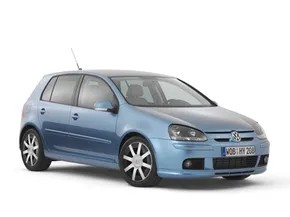
The idea of a diesel hybrid sounds like an engineering contradiction in terms. Diesel engines are heavy. Hybrids are complex. Combining them usually means adding cost and weight to a powertrain already penalized for low-revving torque curves. Yet, Volkswagen and Mercedes-Benz didn’t see it that way. They saw a loophole. A way to squeeze massive efficiency out of internal combustion without surrendering the refinement expected in premium vehicles.
The Golf TDI: Small Block, Big Torque
Volkswagen’s approach was brutally simple. They took the Golf TDI concept and shrunk the heart of the beast. Under the hood sits a 1.2-liter, three-cylinder common rail diesel engine. It’s tiny. It produces a modest 74 horsepower. But torque? It makes 132 lb-ft (178.76 Nm). That’s more twist than many modern small-displacement turbos.
Attached to this micro-diesel is an electric motor. It adds 27 horsepower and 103 lb-ft (139.49 Nm) of torque. The system logic is straightforward. The electric motor handles the standstill. It gets the Golf moving. Once the car gains momentum, the diesel engine wakes up. It only engages at higher speeds or when you demand sudden acceleration.
Volkswagen didn’t stop at the drivetrain. They lowered the suspension. They designed a unique front bumper to slice through the air. Drag reduction was as important as powertrain efficiency.
But here’s the catch. Volkswagen never built it.
Reports from the time suggest the diesel hybrid was too expensive to manufacture. Instead of the complex, costly diesel-electric setup, VW pivoted. They chose a gasoline hybrid powered by both a turbocharger and a supercharger. Cheaper to build. Easier to scale. The diesel concept remained a paper exercise, a testament to what could have been if cost wasn’t the enemy.
The S-Class BlueTEC: Luxury Without the Guilt
If Volkswagen was playing with compact efficiency, Mercedes-Benz was attacking the luxury sedan market’s worst sin: fuel economy.
The 2009 Mercedes S600 is a masterpiece of comfort and gadgetry. It is also a gas guzzler. It averages 11 mpg (4.7 km/l) in the city. 17 mpg (7.2 km/l) on the highway. For a car costing well over $100,000, that’s embarrassing.
At the 2007 Frankfurt Motor Show, Mercedes unveiled a solution that didn’t require sacrificing luxury. The S300 BlueTEC Hybrid concept.
It paired a 2.2-liter diesel engine with an electric assist motor. The diesel did most of the driving. The electric motor filled in the gaps during acceleration. The result? A combined output of 224 horsepower and 413 lb-ft (559.32 Nm) of torque.
Think about that torque figure. 413 lb-ft. That’s V8 territory. It’s comparable to a powerful, naturally aspirated V8, but from a four-cylinder diesel hybrid. The efficiency claim was staggering. Over 40 mpg (17 km/l). In a car of this size and weight.
The AdBlue Factor
How do you make a diesel this efficient and still meet strict emissions standards? You don’t just rely on the hybrid system. You use chemistry.
The S300 BlueTEC Hybrid utilized Mercedes’ AdBlue urea injection system. AdBlue reduces nitrogen oxide (
French engineering has always had a quirky soul. Nowhere is that more evident than in the Citroën C-Métisse, a concept car that showed up at the 2006 Paris Motor Show looking like it had just escaped a fire station. Painted in a aggressive fire-engine red, this low-slung four-door coupe didn’t just turn heads; it twisted the concept of automotive drivetrains into a knot.
It wasn’t just another hybrid. It was a diesel hybrid with a layout that defied standard logic.
The Oddball Drivetrain Layout
Most hybrids put the electric motors where the action is, or mix them with a gasoline engine. Citroën went the opposite direction. They shoved a 2.7-liter diesel V6 into the front of the car. This engine, producing roughly 208 horsepower, drove the front wheels. Meanwhile, the rear wheels were pushed by two electric motors.
This split setup was the key to its character. The electric motors didn’t just assist; they handled a significant portion of the torque. Each rear motor delivered about 295 lb-ft (399.51 Nm). The result? A car that could sprint from 0 to 62 mph (100 km/h) in just 6.2 seconds.
For a diesel, that is brisk. For a concept car from 2006, it was impressive.
Real-World Efficiency and Emissions
Performance was one thing. Efficiency was the other half of the C-Métisse’s promise. Citroën claimed the vehicle achieved an impressive 45 mpg (19.1 km/l). That number holds up against many modern gasoline cars, let alone a V6 diesel.
The car could also run on electric power alone at speeds up to 20 mph (32.2 km/h). This “Zero Emission Vehicle” mode meant urban crawling was silent and fume-free. Citroën emphasized the environmental angle heavily, noting the inclusion of particulate control systems to keep the diesel exhaust clean.
The Economic Reality Check
So why didn’t we see more cars like this? The technology worked. The durability of diesel engines is proven. The fuel economy is undeniable. Yet, the C-Métissa remained a concept.
The barrier wasn’t engineering. It was economics. The initial cost of building a complex diesel-hybrid powertrain was substantially higher than standard alternatives. In the mid-2000s, with oil prices fluctuating but still relatively low compared to today’s peaks, the math didn’t always favor the consumer.
As fuel prices continue to climb, the calculus changes. A diesel hybrid might be more than just a niche curiosity in the future. It sits in a space between the torque and efficiency of diesel and the refinement of electric propulsion.
The Legacy of the Concept
The C-Métisse was a bold statement. It showed that automakers were willing to mix and match technologies in unconventional ways to solve efficiency problems. While it never reached production, its DNA influenced how manufacturers think about power distribution.
If you are looking at how diesel engines work today, or how hybrid systems have evolved, the C-Métisse serves as a reminder that innovation often comes from unexpected places. It wasn’t about following the trend. It was about breaking the rules of where power comes from.
The question remains: will the next generation of drivers choose the proven durability of diesel, the silence of electric, or the complex marriage of both? The C-Métisse already answered that question with a loud V6 roar and quiet electric purr. We are still waiting for the mass market to agree.


