


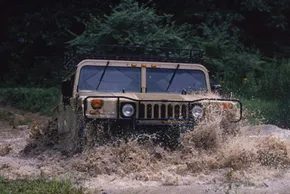
You may have seen army trucks plowing through rivers and flood waters. They go deep into the water. The driving conditions of these vehicles are enough to destroy an ordinary car. One of the biggest challenges is keeping the engine running underwater. Internal combustion engines need air to burn fuel. Exhaust gases must also be removed. If the water is shallow, the pressure takes care of the ventilation. The real problem is air intake. If the air intake is submerged, the engine will suffocate and shut down.
Snorkel solutions and waterproofing needs
You need a snorkel to survive in the deep sea. This pipe raises the air intake above the surface. A standard Humvee snorkel can dive to a depth of 1.6 meters. But snorkeling alone is not enough. The entire vehicle must be watertight. This raises certain technical questions. Are diesel engines more waterproof than gasoline engines?
To get the answer, we need to look at each component. The waterproofing of an off-road vehicle requires the sealing of dozens of parts.
- The electrical equipment, such as the instrument panel, the engine control computer and the lights, must be turned off.
- The fan motor and wiper require protection.
- Batteries must be waterproof.
- The crankcase and differential vents must be sealed or raised to the level of the vent pipe.
- Fuel tanks must be closed properly and vented.
- If water can accumulate in the gaps, they must be emptied.
Once these factors are controlled, the vehicle is able to drive underwater. However, the engine type is important.
Advantages of diesel engines in underwater design
Why are diesel engines the first choice in military crossovers? The reason is in the ignition system. Gasoline engines are dependent on spark plugs and ignition systems. These components operate at high voltages. Difficult to seal to prevent water ingress. This is possible, but adds complexity.
Diesel engines do not have such a system. Compression is used to ignite the fuel. There are also no spark plug leaks. If your diesel engine uses a mechanical fuel pump and mechanical transmission, you can remove the engine control electronics from the equation. No electronics means fewer points of failure. This makes waterproofing a diesel engine relatively easy.
Fords and most underwater military vehicles use diesel engines.
This design choice is no accident. It is very practical. The absence of high-pressure ignition components simplifies the sealing process. There is no need to design complex barriers around sensitive electrical contacts. All you have to do is keep the water out of the air intakes and vents.
What types of motors are suitable for submersible use?
If you’re considering which military vehicles use diesel for flooding, the choice is clear. Diesel’s simplicity wins. Gasoline engines require complex gaskets around the ignition system. Diesel engines require sealing around the nozzle and air passage, but this is usually easier.
That’s why you see diesel powered tanks and trucks crossing rivers. They are made to survive in the abyss. Gasoline engines work well if you try hard enough. But diesel engines are designed that way.
The technical compromises are clear. The torque is sacrificed to some extent because of the Throttle. The use of diesel increases reliability and improves water resistance. Reliability is everything in military applications. Water is your enemy. Simplicity is a defense.
There are still challenges. Seals deteriorate. The rubber hardens. Modern diesel engines have more and more electronics. But the basic principles remain. There is no spark plug. Reduces complexity. Increases survivability in humid environments.
River doesn’t care about fuel efficiency. The most important thing is to keep the engine dry. The diesel engine continues to operate. Gasoline engine drowned.


