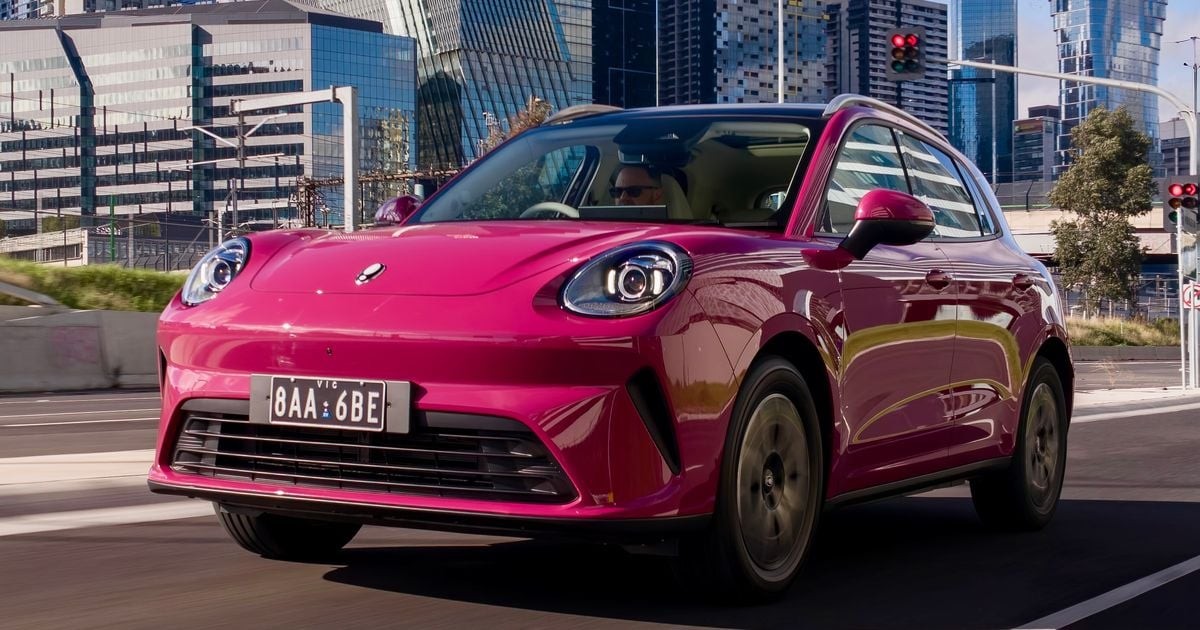
Great Wall Motor finally dragged another EV into the Australian spotlight.
This time it isn’t the forgettable hatch that faded into obscurity two years ago. It’s the Ora 5.
An SUV.
GWM is pivoting hard. They realized the tiny Ora hatch got crushed by the BYD Dolphin and the MG4. So they scrapped the plan. Built a proper compact SUV. And priced it like a joke.
The 2026 Ora 5 lands in Australia as a direct threat to the budget EV segment. It sits below the BYD Atto 3, undercuts the MG S5, and mocks the Chery E5 on paper. The trick? They kept the old hatch’s price point while adding size. And tech.
It is cheap enough to make people suspicious.
But maybe just cheap.
The Lineup Is Coming Fast
The SUV is only the start.
GWM has announced nine new models for Australia over the next six months. A massive onslaught of combustion engines, hybrids, and electric boxes. The Ora 5 comes in three shapes eventually: the SUV seen here, a lower-riding hatch with a smaller battery, and a stretched “Touring” wagon with more range later.
We only tested the top-spec Ultra.
The roads were Victorian. Mix of city and country.
How does it stack up against the BYDs and Cherys of the world? Does a Chinese brand looking to shed its bargain-basement image succeed?
The Ora 5 isn’t just another copy-paste EV. It tries harder to be an actual car.
Price Tag That Makes Competitors Nervous
Drive-away price starts at $33,99.
GWM claims it is Australia’s most affordable electric SUV
True.
The BYD Atto 2 lists for $31,90 before costs but hits about $35k when you actually drive it. The Atto 3 starts higher, around $39k plus on-road costs. The MG S5? Over $42k. The Chery E5 is close, at $37k drive-away, but still higher than the Ora’s entry price.
The Korean brands are left fighting in the deep water. The Hyundai Kona starts at $46k. The Kia EV3 is nearly $48k.
If your budget caps at $35k and you need an electric SUV, the field just narrowed to one name. Or maybe two.
Inside the Cabin
Open the door and you smell the plastic. Not bad plastic. Nice synthetic leather.
The interior follows the Chinese playbook: huge screens. A 14.6-inch iPad-sized tablet dominates the dashboard. It looks sharp. It responds fast.
And yet.
They gave us chrome-look buttons. Four of them. Below the screen. We thought this was progress. Physical switches for climate? Finally. Then we pressed them. They do almost nothing. Toggle A/C on? Check. Demister? Check. Auto climate? Check. That’s it.
No volume knob. No temperature dials. Just on/off toggles for things we rarely toggle.
We wanted fan speed control here. We got a menu.
It is a minor annoyance but a telling one. GWM hid the real controls in a persistent ribbon at the bottom of that big touchscreen. You have to hunt for the heat. Then hunt again for the fan speed. It works, but it feels like they added physical buttons just to say they had them.
The colors? The Ultra model offers a Flamingo Pink exterior with a “strawberry and cream” interior. Cute? Maybe. For kids with muddy knees? A disaster.
Stick to the dark grey. The base Lux trim gets cloth seats. Sensible choice.
Comfort is actually the winner here.
GWM claims their seats passed 61 internal comfort evaluations. Who knows what that means but our backs didn’t complain. The seats power adjust well. The Ultra adds heating and ventilation. The cooling vent allegedly pulls heat away from your back. It works.
There are more than 30 places to stuff stuff. Thirty.
An umbrella slot in the door bin is hidden away. Subtle. Classy. Also requires buying a separate umbrella because putting a free one inside the car would be too European. We dig the attention to detail. Even if it is plastic.
The back seat? Decent legroom. Headroom is fine if you aren’t a giant. Tall passengers behind tall drivers will suffer. No center armrest. One USB-C port for the entire back row.
But the panoramic roof makes the space feel airy.
The boot is small.
362 liters. That is tiny compared to the Atto 3’s 440L. The sloping rear design kills vertical space. But there is a saving grace: a spare tire.
Real.
Not a inflator can. Not foam. A wheel.
GWM said Australians wanted this. It takes up some boot space, yes, but the load floor raises up to hide it. You get a flat loading bay. It is rare for an EV at this price. Almost unheard of.
What’s Under the Bonnet
One motor. Front wheel drive.
It makes 150kW and 260Nm. Not exciting numbers on paper. The battery is a 58.3kW LFP pack.
Official WLTC range sits at 435km.
Real-world driving in our mix of highway and town showed consumption around 18kW/100km.
That’s average. Good. Not great. Not terrible.
Driving: Stiff But Precise
Here is the surprise.
The drive quality does not feel Chinese.
Why? Because Rob Trubiani tuned the suspension. Yes. The ex-Holden guru helped GWM set up the chassis. And you feel it.
The old Chinese SUVs bounced. Wallow. Bobbled around like boats on rough water. The Ora 5 sits still.
The steering is direct. Sharp. Easy to thread through narrow city streets or tight car parks. The car feels planted on the freeway. No wobble.
But it is harsh.
Too harsh.
The suspension is stiff. Small cracks in the tarmac slam up through the steering wheel. Pumps sting your spine. It feels like GWM was so afraid of the “wobbly” stereotype that they went the opposite extreme. This is not a sports car. It is a commuter EV. It should cushion.
And then there is the throttle.
It feels doughy. Mushy. You press the pedal. Nothing happens. Then suddenly you launch. It lacks linearity. On a wet road, floor it from a standstill and the front tires will smoke. Torque steer kicks in during sharp turns.
Brakes are solid. Predictable. The regeneration settings are annoyingly buried in the screen. You have to find the right drive mode menu to adjust regen levels. Then you press a vaguely labeled star button on the steering wheel to switch drive modes. It is clumsy. Hyundai gives you paddles. GWM gives you a menu dive.
Still.
Once you get used to the pedal lag, the Sport mode wakes up the power delivery. The car pulls well. Cabin refinement is high. Road noise stays out. Only really coarse roads leak sound.
The driver aids? Calibrated well. Not jerky. Lane keeping isn’t aggressive. But using the right-hand stalk for cruise control while also using it to select Gear feels weird. Shift into ‘D’ to start. Shift into ‘R’ to stop? Intuitively unsettling.
The Verdict?
It is flawed.
The ride is too firm for the average driver. The screen menus for climate and regen are frustratingly indirect. The throttle lag requires a learning period.
But for $33,90 drive-away?
You get a car with a spare wheel. Real suspension tuning that eliminates the boat-like drift of cheaper rivals. A cabin that feels sturdy. Good materials.
The BYD Atto 2 might be slightly cheaper on the list. But the Ora 5 feels more complete. More built.
GWM knows what they did here.
They didn’t build a perfect car.
They built a bargain. One that doesn’t quite apologize for itself.
Is the stiff ride worth saving $10k?
Maybe. If you ignore the bumps.