“Check Engine” light flashes. Again. I paid for the fix last month. The sound of the engine has become a little rougher. The suspension now vibrates more than before. You hate to admit it, but the thought keeps nagging at you: “Is it time for the old faithful to go?”
How much will the repair cost? This is the question that everyone has been asking. It can be helpful to establish a long-term baseline for your car’s maintenance costs.
The average American household owns 1.9 cars. They spend about 1.5% of their annual income on maintenance. In 2004, the typical household income was $54,453. This means that approximately $817 is spent annually on repairs. or $408 per vehicle. This excludes gasoline and oil (3.7% or $1,007 per vehicle) and insurance (2.2% or $599 per vehicle).
Is it expensive? It depends on your point of view. Cars are complex machines with predictable lifespans. Manufacturers expect certain parts to fail frequently. You replace those during regular maintenance. Other components last longer. Long-lived components are more expensive to replace. However, if you spread the cost over the life of your car, the burden is lightened. Spending $500-$800 on an alternator hurts less if you drive it for 75,000-100,000 miles (120,701-160,934 km).
If you drive your car long enough, you end up replacing or rebuilding most of it. This is not necessarily a bad idea. New cars are expensive. They depreciate by an average of 45% in the first three years. Ranging from 48.3% to 79.3% over 5 years.
The value of car preventive maintenance
Annual maintenance costs of over $400 seem high. This is no big deal compared to buying a new car. Especially if your current car is paid off. It is estimated that driving a paid car for another five years can save you the same amount as buying a new car.
Let’s compare a new car and a paid-for car that has been serviced. Make it fun by stack the deck to match your new car. Let’s say you drive 24,000 miles (38,624 kilometers) a year. This is twice the national average. 120,000 miles (193,121 kilometers) in five years. This means 35-40 oil changes. At $40 each, that’s between $1,400 and $1,600. Let’s call it $1,500.
Add $2,200. Filters. Hoses. Tire rotation. Add $1,500 for major items. Timing belt replacement. New brakes. Shock absorbers. That adds up to $5,200. or about $1,040 a year.
Now let’s look at the new car. According to the National Automobile Dealers Association (NADA), the average price of a new car in the United States in 2009 was $28,966. Lowball it. Let’s say you find a deal for $24,000. You finance $20,000 at 7% interest for 48 months. That is a monthly payment are just under $479. The total is $5,747 per year.
In other words, for the cost of buying a new car in one year, you can own a paid-off car for five years. Drive it into the ground. There is still money left to for tolls.
According to Consumer Reports, the average lifespan of a new car is about eight years or 150,000 miles. A properly maintained car means safer travel for you and your loved ones. Who can put a price on that?
The most important areas of car preventive maintenance
See the owner’s manual for detailed schedules. The main areas to focus on are:
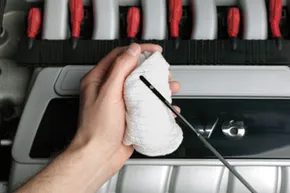
- Change the engine oil regularly
- Monitor all liquids
- Maintain transmission
- Replace the spark plugs if necessary
- Observe the timing belt
- Flush the radiator
- Replace all filters
- Fight rust
- Maintain good driving habits