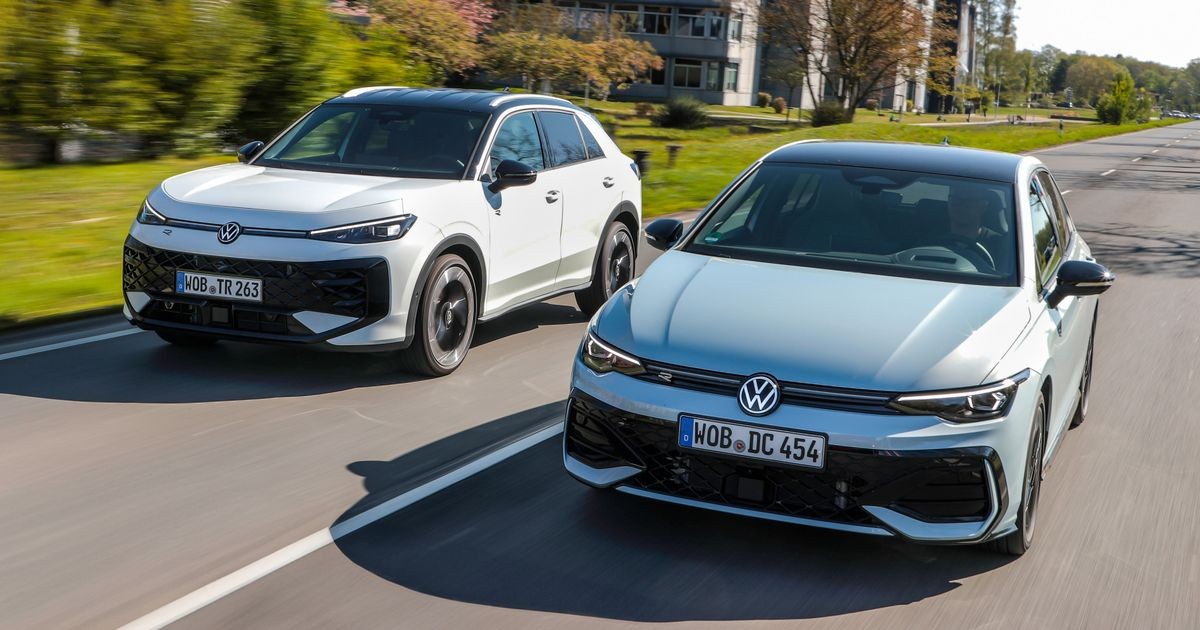
Volkswagen has officially unveiled its new full hybrid technology, marking a significant step up from its existing 48-volt mild-hybrid systems. This new powertrain will debut later this year in the updated Golf and T-Roc for the European market, designed to bridge the gap between standard petrol cars and plug-in hybrids (PHEVs).
For many drivers, this represents a “sweet spot” in electrification: it offers better fuel efficiency and lower emissions than conventional engines, without the range anxiety or charging requirements associated with PHEVs.
How the New System Works
At the heart of this new drivetrain is a sophisticated combination of internal combustion and electric power. Volkswagen pairs its ubiquitous 1.5-liter TSI ‘evo2’ turbocharged petrol engine with two electric motors and a compact 1.6 kWh lithium-ion battery.
Unlike simpler mild-hybrid systems that only assist the engine, this full hybrid system can operate in three distinct modes:
- Electric Mode: At low speeds, the vehicle runs solely on electric power, allowing for silent, zero-emission driving in urban environments.
- Series Mode: The petrol engine acts as a generator, producing electricity to power the drive motor and charge the battery. The engine is decoupled from the wheels, optimizing efficiency.
- Parallel Mode: At higher speeds (typically above 60 km/h), the petrol engine takes over as the primary power source, while the electric motor provides additional boost during acceleration.
The system uses an electronically controlled multi-plate clutch to seamlessly engage or disengage the petrol engine, ensuring smooth transitions between modes. Additionally, features like an electric air-conditioning compressor and an electric brake servo are integrated into the front end, further reducing load on the engine.
Driving Dynamics and Efficiency
Volkswagen emphasizes that this system is designed to balance efficiency, dynamics, and comfort. Drivers can tailor the experience using three profiles:
- Eco Mode: Limits power output to 70% and deactivates the boost function to minimize fuel consumption.
- Comfort Mode: The standard setting, offering no power limits and keeping the boost function available for balanced performance.
- Sport Mode: Prioritizes performance by switching to series-hybrid mode earlier, ensuring full power is readily available.
According to Volkswagen, this setup enables a higher proportion of electric driving compared to their mild-hybrid counterparts, resulting in lower emissions and fuel consumption. Crucially, it achieves this without the need for external charging infrastructure, making it a practical option for a wider range of consumers.
The Australian Market: A Case of Uncertainty
While European customers will see these models hit showrooms later this year, the outlook for Australian buyers remains ambiguous. Volkswagen Australia has not confirmed when—or if—these new hybrid variants will arrive locally.
This delay is notable given the current state of the local lineup:
* The Golf: Australia continues to receive an older 1.4-liter TSI petrol engine paired with an eight-speed automatic, a combination largely reserved for markets with less stringent emissions regulations, such as the US and South Africa.
* The T-Roc: Despite being revealed in Europe eight months ago, the revamped T-Roc has not yet been introduced to the Australian market.
Volkswagen Australia cites ongoing assessments of future opportunities for the local market but cannot provide a timeline. Meanwhile, sister brands within the VW Group—such as Audi, Skoda, and Cupra—are already offering mild-hybrid and plug-in hybrid options in Australia, often based on the same MQB evo platform.
“While Volkswagen Australia continues to assess future opportunities for the local market, we’re unable to confirm Australian availability or timing at this stage,” Volkswagen Australia stated.
Why This Matters
This launch signals a strategic shift for Volkswagen in the compact car segment. By introducing a full hybrid option, the brand aims to offer a comprehensive spectrum of electrified powertrains, ranging from mild-hybrids to all-electric vehicles.
Given that the MQB evo platform is shared across numerous VW Group brands, this technology is likely to roll out to other models in the near future. However, for Australian consumers, the question remains: Will Volkswagen prioritize local electrification, or will it continue to lag behind global competitors?
The introduction of these hybrids in Europe sets a new benchmark for efficiency and performance. Whether Australia gets to experience this technology depends on Volkswagen’s ability to align its global strategy with local regulatory and consumer demands.