Honda is having a bad year. Actually, make that several bad years.
The automaker just recorded its first annual profit loss in 70 years. They scrapped three EV plans. Now they are quietly planning to keep the Ridgeline alive until the next decade. It just won’t be the same truck you drive today.
The second-gen unibody pickup is nearly 10 years old. Launched for the 2018 model year (yes, it arrived early, that’s car marketing for you), it needs an update. A third-gen replacement? Too early for that. A refresh? Coming soon.
Reports suggest production pauses in Q4 this year. Restarting in Q3 of 2028?
When it returns, the truck will wear new clothes and hide a new engine. The goal? Meet stricter emissions rules while facing tougher competition. Ram’s coming Dakota. Hyundai’s new Santa Cruz successor. The herd is growing.
Name Day
Honda introduced the Ridgeline twenty years ago. The original used a 3.5-liter V4. It made 255 horsepower. It could tow 5,000 pounds. Independent suspension. All-wheel drive. It was different then, just as it is now.
There was a gap between generations. No Ridgeline for 2015 or 2016. Then the current model launched for 2017. It’s gotten small tweaks since. The TrailSport trim arrived for 2024 to some acclaim.
Will they change the name? Doubt it. “Ridgeline” works. We’d bet the next version leans harder into that TrailSport identity. Off-road badges sell.
Looks Matter
Don’t expect a shape-shifter.
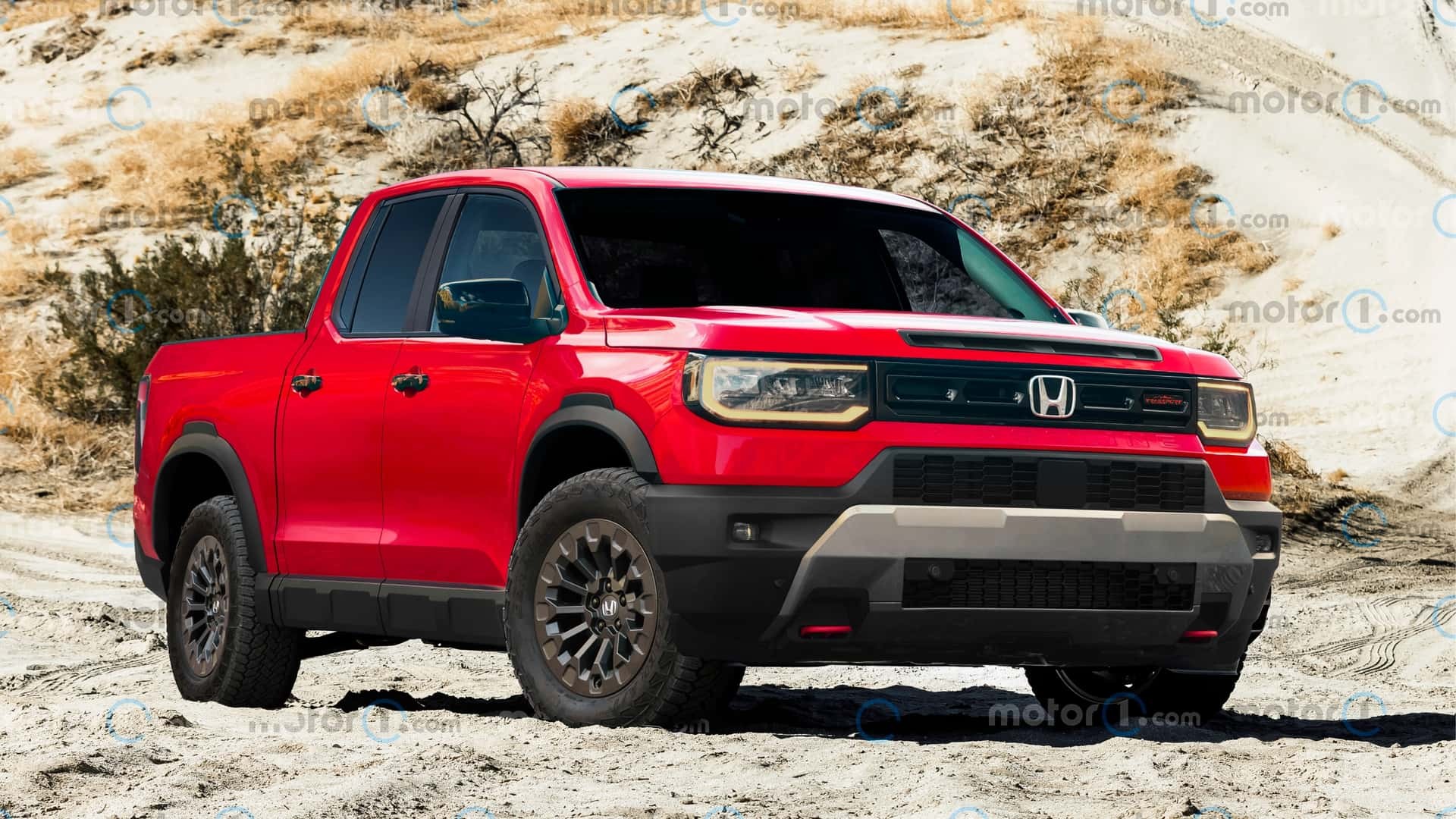
It will sit on the same platform. This means the skeleton stays the same. The skin gets a refresh. Think Passport. The midsize SUV has been selling well. Its new boxy aesthetic is catching on.
Expect the Ridgeline to borrow that language. Square headlights. A slimmer grille with the logo right in the middle. Red tow hooks. A skid plate on the front bumper. Even a hood vent because style.
The back end? Tall taillights with a T-shaped motif. Mirror of the Passport. If you take the cabin off the new Passport and add a bed, that’s roughly what we are looking at.
Is that radical design? No. But it keeps it fresh.
Under the Hood
Here is the technical part. Keep up.
The current Ridgeline uses the 3.5-liter J-series V6. 280 horsepower. Single overhead cam. It gets the job done.
The new version likely swaps this for the J-series engine found in the Pilot and updated Passport. The J35Y8. It has dual overhead cams. No VTEC, but slightly more power. We’re talking 285 horsepower here.
There’s also talk of a new hybrid V6 in Honda’s pipeline. That engine comes out next year. Probably before the new Ridgeline hits the road.
So expect a mild power bump. More importantly, the transmission might change. Goodbye, 9-speed. Hello, 10-speed automatic. You know the one. It’s in the Pilot. It has paddle shifters.
Same Bones
It rides on the PF7 platform. Shared with the Pilot. Shared with the Passport.
Honda won’t reinvent the chassis for a mid-cycle refresh. They don’t have to. The geometry is fine. But don’t assume the ride stays identical. Engineers might tweak rigidity. Maybe boost safety margins. Small tweaks. Quiet changes.
Timing Is Everything
If production halts this year, the debut window opens mid-2027. Maybe.
Honda could hold back. Wait until early 2028 for a formal reveal. The model year? Likely 2029.
Wait so long? Yes. Supply chains stabilize. Emissions tech matures. You drive the old version in 2026. Then again in 2027. Then the new one appears.
Price Check
Let’s talk money. Because cars cost money.
The 2026 Ridgeline Sport starts at $42,295 (with destination charge). The TrailSport? $46,490. The top-tier Black Edition? Nearly $49,395.
That puts it above the pack. The Ranger, Tacoma, Colorado, and Frontier all start in the mid-$30k range.
The updated model? Don’t expect a discount. Inflation doesn’t sleep. Production pauses add overhead. We see a starting price creeping past $40,000 easily. Maybe touching $45,000.
Will people buy it? They have so far. The unibody setup handles like a crossover. The dual-action tailgate is still cool. The Innegra-bed won’t rust.
Is that enough to justify a premium over a body-on-frame work truck?
That’s the question. And the market will decide.