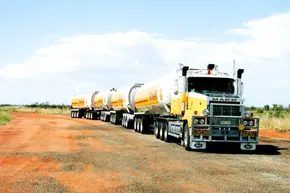
Kangaroos are everywhere. Koalas are adorable, even if they are perpetually grumpy. But if you want to see something that actually terrifies the average driver, look for the road train. These aren’t just big trucks. They are the undisputed bad boys of the Australian Outback. Forget the caricature of a shirtless crocodile wrestler in a dusty vest. This is a mechanical beast so massive, so dangerous, that it is banned in most populated parts of Australia.
If you are driving a passenger car and spot one of these “truck trains” barreling toward you on the barren highways, you need to know exactly what to do. When a road train gets up to speed, stopping it becomes nearly impossible. It is a physics problem that doesn’t care about your panic.
Why the Outback Needs Massive Rigging
Australia is a continent of extremes. Most people live on the coast. The cities are pleasant there. The weather is kind. But the resources? The livestock? The grain? The fuel and ore? They are in the middle. In the red dirt. The empty, desolate center.
Shipping goods along the coast makes sense for a tourist. It is scenic. It is safe. But for a logistics company, it is a waste of time and fuel. There is no real alternative. You have to drive straight through the middle. And to do that efficiently, you need a vehicle that can haul tons of cargo across thousands of kilometers of cracked earth.
From Camels to ‘Bertha’
It wasn’t always this way. In the 19th and early 20th centuries, camels did the heavy lifting. They marched across the continent until the 1930s. Then came the motorized caravan. But the camels had a limit. So did the early trucks.
Enter Kurt Johannson. A man from Alice Springs, right in the geographic center of the country, Johannson saw a problem. The existing rigs couldn’t handle the weight or the distance. He didn’t have a fancy engineering degree. He had access to scraps. Specifically, a tank retrieval tractor left behind by the American Army during World War II.
He modified the tractor. He built custom trailers to haul cattle. He named the whole rig “Bertha.” And then he unleashed her.
“He then built some trailers to haul cattle, named the entire rig ‘Bertha,’ and unleashed the first road train on the unsuspecting Outback.”
That was the birth of the modern road train. It wasn’t pretty. It was loud. It smoked. But it worked. And once it worked, everything changed. The Outback opened up. But so did the danger.

这种怀疑是真实的。 如果你在美国呆过一段时间,你就会知道那种感觉。 你坐在你的小轿车里,被一辆爬山的牵引拖车围住,感觉到它们经过时猛烈的湍流拍打着你的后视镜。 或者更糟糕的是,喷雾。 你把雨刷器调到最快,祈祷它们能跟上你前面轮胎上的洪水。
那没什么。 这是一个热身。
在美国,标准的半挂车组合长约 70 至 80 英尺(21.3 至 24.4 米)。 无需特殊许可,其重量约为 40 吨(36.3 公吨)。 它很重。 它很大。 但在澳大利亚,他们看到了这一点并找到了一个起点。
巨兽的构造
Different rules apply in Australian logistics. Two standard trailers can be connected to one truck, a configuration called B-double. Add a third and you get a B-triple. However, it is not a road train. These are “long vehicles” only.
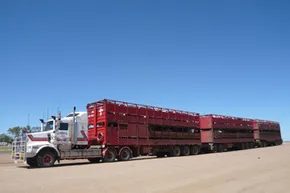
Real road trains are beasts. Connect two or three trailers together using a converter dolly. These dollies add an axle to distribute the weight and prevent the road from collapsing. result? The rig can reach up to 164 feet (50 meters). It is more than twice the length of an interstate highway in the United States.
Want something bigger? Buy a B-double and connect an extra trailer with a converter. You now have a monster that is 175-foot (53.5-meter) monster. This is the legal limit on public roads. Is it on a private road like a road with large scale mining in the Outback? There are no restrictions. You can connect as many trailers as physics and logistics allow.
The train weighed 220 tons (200 metric tons) when fully loaded. Think about it. That’s more than five times the weight of a semi-trailer on Iowa highways.
驾驶员
To use that much steel, you need something more than a CDL. When you’re driving 200 tons (181.4 tons) of steel across desolate, empty terrain, you need a truck that’s built to survive.
Manufacturers such as Freightliner and Kenworth build these rigs in millions of configurations. It’s not just about horsepower. This is for the sanity of the driver. On longer journeys, sleeper box and lockers are non-negotiable. The cabin must be quiet and insulated from the relentless engine noise and wind blowing through the 175-foot structure.
What is the climate like? Brutal. In Western Australia, temperatures regularly reach 120 degrees Fahrenheit (49 degrees Celsius). Air conditioning is not a luxury here. it’s a life-support system.
Heat is the engine’s enemy. Maximum ventilation and cooling is required. A cool engine doesn’t blow up in the middle of nowhere. In addition, a cooler engine improves fuel efficiency. This is important if you don’t have a gas station every few kilometers. Even if you could, pulling in 170 feet (51.8 meters) for a quick refill or Slurpee isn’t very efficient.
Reliability is everything. If your truck breaks down, it can take 10-12 hours to find a mechanic who actually knows how to fix this huge vehicle. Roadside assistance can also arrive by propeller plane. You can’t afford to be stuck.
Next is the human factor. Fatigue kills. Drivers can choose to travel for 21 hours straight, but this is strongly discouraged by the Australian Road Train Association (ARTA). We recommend working up to 14 hours a day in a 14-day period instead of a regular week. But let’s be honest: staring at the endless horizon for 21 hours is a test of mental strength that few can withstand.
打破记录
在看到数字之前很难掌握这些行动的规模。 2006 年 2 月,公路列车创下了挂接 112 辆拖车的纪录。 每辆拖车都超过 33 英尺(10 多米)长。
总长度? 4,836.9 英尺(1,474.3 米)。
从长远来看,这比 40 头头尾相接的蓝鲸还要长。 火车仅行驶了 330 英尺(100 米),就正式创下了纪录,但那条机械龙向前倾斜的形象足以让任何司机检查自己的盲点两次。
如何玩好公路列车
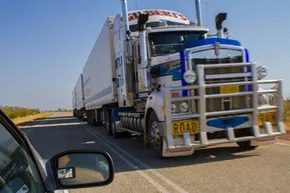
The real threat to Australia’s highways is not infrastructure. It’s the people. Imagine an exhausted or over-caffeinated driver steering over 400,000 pounds (181,437 kg) of agitated cattle at 56 mph (90.1 km/h). They cross deserts so empty that a breakdown the pilot has to land and help. Physics is merciless here. This huge platform can’t stop in time for the single sedan that decides to cut it off during the twenty-one hours drive. The car becomes a cartoon pancake. You don’t want to be that car.
When you’re in a remote area, ignore the urge to play hero. Follow these rules to avoid roadkill.
Don’t Cut Off a Road Train
Simple physics applies. That mass takes forever to decelerate. If you pull out in front of a road train, you sign your own death warrant. A truck needs miles to stop. Give them space. Always.
Don’t Pass During Turns
Do you see the turn signal? Move over. Don’t try to slide into an empty lane to pass. These rigs require large turning radii. They use all available lanes. If you get in their way when they turn, you will be crushed. Let them complete the maneuver.
Stay in your lane on the far left
If you drive on the left in Australia, the danger zone is on the right. When a road train approaches, do not stick to the center line. Stay as far to the left as your lane allows. The truck often drifts over the line to avoid debris or maintain speed. If you’re in the middle of the lane, you’re in its path. Stay left.
Only Pass If You Can See 2 Miles
The road train is 170 feet (51.8 meters) long. Even if it moves slowly, it takes a long time to pass. Visibility must be at least 3 kilometers before you move into the oncoming lane. If you can’t see that far, don’t pass. Blindly accelerating into oncoming traffic is a fatal mistake.
Keep up the speed
If there is a road train behind you, do not slow down to let them pass. They can’t brake as fast as you. When you brake, you close the gap. You provoke a rear-end collision that results in you under 400,000 pounds of steel and beef. Keep the speed constant. Let them pass if you have to, but don’t encourage their failure to stop you.
Pull Over and Wait
The turbulence and dust of a passing road train are strong. It feels like a storm is hitting your car. If you feel unsafe, pull way off the road. Stop completely. Wait for the dust to settle. Don’t try to ride the wake or accelerate to get ahead. It’s scary and an unnecessary risk. Just stop. Drive safely.