Rome again. It had to be Rome. Seventy-nine years after the 125 S took that first win on local streets, the brand is back in the capital. This time to drop the bombshell that signals the start of something new. Or rather. Something parallel.
“It’s not the electric Ferrari.”
They insist it’s a multi-energy strategy. Petrol cars aren’t dying. Hybrid systems linger. The new fully electric Luce sits beside them all. It is Maranello’s most significant launch in years, but also a departure in form.
The First of Two Firsts
Look closer at the sheet metal. This is the first five-seat Ferrari ever. Only the Purosangue has offered four doors before this. The Luce is the second four-door badge to carry the prancing horse. Significant shifts usually come with significant patents. There are more than sixty new ones involved here. Every motor, every battery cell designed in-house. Nothing bought.
Then there is the design credit. Usually. Flavio Manzoni runs the in-house shop. This time. Ferrari walked over to LoveFrom. Sir Jony Ive. Marc Newson. The creative collective formerly of Apple fame. Ferrari gave them the brief then left them alone. For six months. Silence. No slides. No renderings. Just two books delivered when the deadline hit. The vision in those pages maps closely to the car you see now.
A Glass House on Wheels
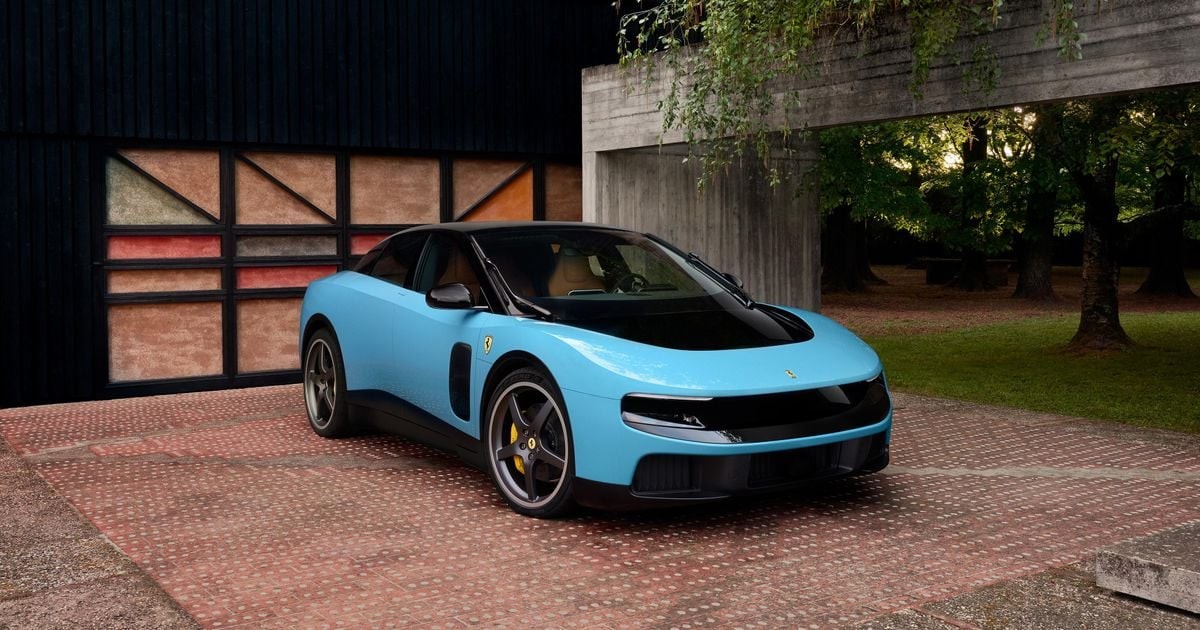
The result is what they call the “glass house.” A massive glazed cabin volume. Floating aerodynamic wings wrap around it like protective armor. The shape is strikingly clean. Aggressively simple.
They talk about permeability. Air flows through the car now, not just around it. Channels cut between the wings and bodywork manage the drag. The tail-lights? A deliberate callback to the 365 Modena and the 458 Italia history books.
It sits on huge wheels. Twenty-three inches up front. Twenty-four out back. The largest staggered fitment ever on a production Ferrari. You get forged five-spokes if you want lightness or turbine styles if you want aero. That latter choice drags the coefficient down to 0.254. The most aerodynamic road-going Ferrari ever made. Launch color is Giallo Luce. Yellow from the old logo.
Power That Thinks
Underneath lies the machinery. Four motors. One for each wheel. It is only the second AWD electric Ferrari. The first being the plug-in hybrid SF90. The output numbers are loud. 772 kilowatts. 990 Newton meters of torque from the motors. Ferrari claims peak axle reduction pushes wheel torque to 11,500 Newton meters. That sounds insane. Probably is.
Three modes exist.
- Range cuts power to 320 kW and disconnects the front axle.
- Tour bumps it to 460 kW.
- Performance unlocks 725 kW.
Hit launch control. You hit 1050 CV for a few seconds. The numbers follow suit. 2.5 seconds to 100 km/h. 6.8 seconds to 200 km/h. Top speed hits 310 km/h. All that while carrying 2,260 kilograms.
How? Low battery placement. Center of gravity drops lower than the SUV. It turns like it weighs 400 kilos less. Physics doing its job.
The battery packs 122 kWh on an 800-volt grid. Range sits above 530 km. Fast charging hits 350 kW. Add 70 kWh in twenty minutes if the charger holds up. And here is a detail people miss. The battery cells can be swapped. When better tech arrives. You might get an upgrade down the track.
Sound is another pivot point. No fake audio piped through speakers. Instead an accelerometer sits on the rear axle. It catches the vibration of motors and gears. Filters it. Amplifies it. Like an electric guitar pickup. You hear it outside too. But only when you push it hard.
Inside the cockpit there is a shift toward tactility. Recycled aluminum steering wheel. Five-position Manettino dial sits next to a new e-Manettino. Real dials share space with OLED screens in the binnacle. Gorilla Glass touches everywhere. Anodized aluminum. Twenty-one speakers. Even the key uses an E-Ink display. A first in auto history.
There are paddles behind the wheel too. Not for gears. They step the power up. Or dial in regenerative braking. Ferrari calls this a “torque language.” Traction control learns how you drive. You prove you are skilled? The limits rise.
Ownership includes seven years of maintenance. Eight years covers the electric bits. Pricing for Australia remains quiet. Timing too.
But the arrival matters. A five-seater. Four doors. Everyday EV utility. Yet the brand keeps building V8s and V12s.
It forces a question about what the badge actually means now. Maybe the answer doesn’t fit in one car. Maybe it needs to fit in three.