If you know the compact SUV landscape, you likely already know the usual suspects. The Honda CR-V and Toyota RAV? They’re the industry’s safe bets. The mass market favorites.
But for people who actually enjoy steering wheels?
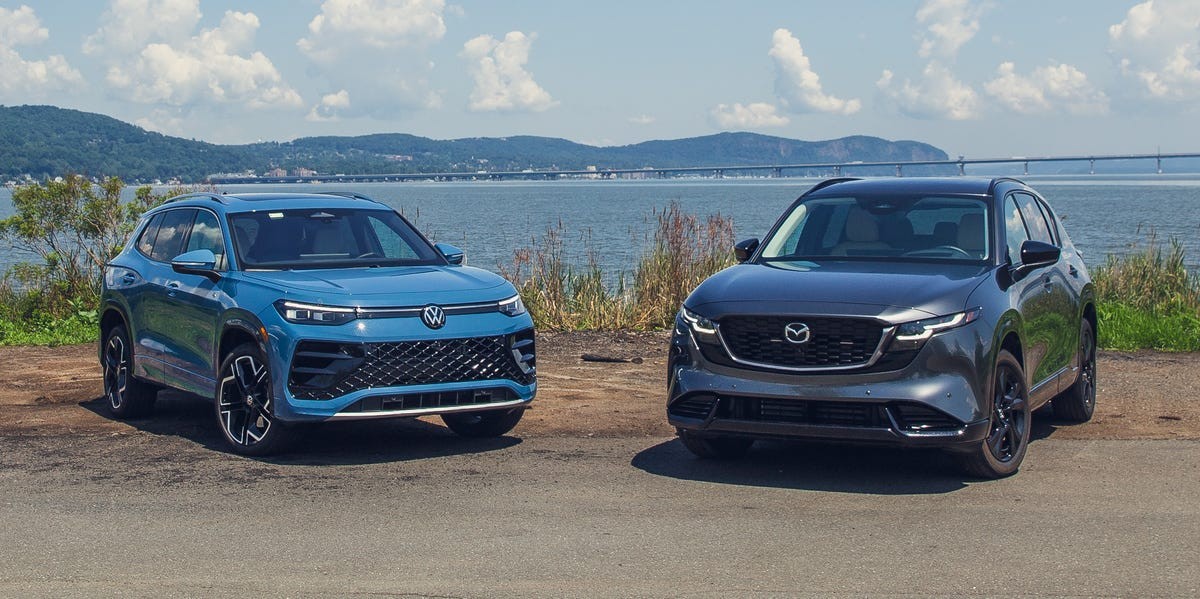
That’s where the Volkswagen Tiguan vs. Mazda CX5 comparison gets interesting. These two are the outliers. They don’t just move metal from point A to point B. They offer personality. Distinct, polarizing personalities. Like comparing a minimalist’s studio apartment to a curated gallery.
We just tested the newest versions of both. The 2025 Tiguan and the upcoming 2026 CX-5. The goal was simple. Find out if they still matter for enthusiasts or if they’ve sold out to comfort seekers.
Which Engine Should You Choose in the VW Tiguan vs. Mazda CX?
Power matters. Or does it?
Mazdia has made a strange pivot. For the 2023-2024 CX-5, you could buy a turbo. It was peppy. Fun. Now? It’s gone. The entire 2026 lineup rides on a single naturally aspirated 2.25-liter inline four. 187 horsepower. That’s it. Until the hybrid arrives, that’s your only engine option.
The VW Tiguan plays a different game.
We tested the SEL R Line Turbo. It packs a 2-liter turbo four that pushes 268 horsepower. It is, hands down, the most powerful standard engine in the compact segment right now. Even the base VW Turbo makes 201 hp.
Let’s look at the price tag, though.
Our test Mazda CX5 Premium Plus came to $41,030.
Our test VW Tiguan SEL R-Line Turbo sat at $45,4410.
You pay for the boost. But what do you get for that extra $4,400?
The Tiguan’s instant torque feels like cheating compared to the Mazda’s linear pull.
In a straight line, the difference is night and day. The VW R Line hits 60 mph in just 6.7 seconds. The Mazda takes 8.0 seconds. And if you buy the base non turbo Tiguan, it still loses to the Mazda by half a second. 8.5s.
So. Which engine configuration fits your driving style? If you want to merge with confidence and smile when you floor it, the VW Tiguan is the obvious choice. The Mazda asks you to rev the engine harder just to get it moving. It’s not sluggish. But it requires work. The Turbo doesn’t.
Exterior Style and Interior Space in Compact Crossovers
Do these cars look good? Yes.
Both skip the bland design of the segment leaders. The new Mazda CX5 looks almost identical to its predecessor. Just new lighting signatures. Headlights and taillights have been sharpened up. The proportions remain athletic. Upscale. It looks like a premium product because it’s trying hard to be one.
The Tiguan is different.
Some might call the new VW shape blob like. Others might call it modern. It has a stance. Thick shoulders. LED accents that give it attitude without looking aggressive.
Inside is where things get messy.
Both brands went full tablet mode. Large touchscreens dominate the dashboard.
Mazda: 15.5-inch screen.
VW: 15-inch screen.
You’ll miss knobs.
Trying to adjust your AC temperature means tapping icons. It’s fiddly in the Mazda. It’s slightly better in the VW because the menu layout is more logical. But neither experience feels physical. You are commanding a computer. Not driving a car.
However. The Volkswagen interior feels more expensive to touch. Wood grain accents. Real metal trim. It has that near-luxury vibe.
Mazdia used to be king of soft-touch materials. The 2023 CX5? Soft plastics. High quality. The 206? Hard surfaces on the dashboard. It still looks nice. But when you run your hand across it? It feels like hard plastic. A step back.
Space? A tie. Mostly.
Mazdia stretched the wheelbase. The rear seat is roomier than before. Legroom is adequate. Comfort is comparable to the VW. But for cargo? The Tiguan wins. Fold those seats down. The VW gives you a larger flat load floor. More volume.
Handling: Is the Mazda CX Still a Driver’s Car?
This is the most important part. The soul of the car.
Does the new Mazda CX-5 handle like a sports sedan in a SUV body?
Not anymore.
The new CX5 suspension is softer. Softer suspension means the body floats a bit over bumps. It’s more compliant. Which sounds nice on a bad road. And it is. It absorbs imperfections better than the VW. It’s comfortable.
But it lacks precision.
The VW Tiguan handling is sharper. Much sharper. The steering is direct. The turn-in is accurate. You point it there and it goes. It stays flatter through corners.
Wait. Did you catch that? The Tiguan handles better despite having less grip?
Yes. On a skid pad, the Mazda actually holds onto the asphalt tighter. 0.83g for the CX. 0.0g for the Tiguan.
How does that work?
Grip is raw physics. Feel is psychology and engineering. The Mazda has grip. But the Tiguan communicates it. The stiffness of the suspension helps. The larger wheels on our tester add harshness, sure. Road buzz transfers in. But it tells you where the limits are.
The new Mazda feels… syrupy. Sluggish in the corners. It rolls. It wanders slightly.
The old CX-5? A legend in the segment.
The new one? A good crossover. Just a good crossover.
The Mazda CX5 driving dynamics haven’t been killed. You can still have fun. The steering ratio is good. It doesn’t feel dead. But compared to the 205 predecessor? It’s been watered down. And compared to the Tiguan R-Line performance? The VW feels alive in a way the Mazda no longer does.
So which SUV should you actually buy?
This depends entirely on what you value.
If you need cargo space and want the smoothest ride possible for commuting, the Mazda has a strong case. It fixed the rear seat cramping. The new engine is reliable. The price is lower.
But the question remains: why buy a Mazda in this segment if it no longer drives differently?
The VW Tiguan 205 review points to a winner in terms of holistic excitement.
– Better acceleration
– Sharper steering
– Higher perceived interior quality
– More cargo volume
The VW gives you performance and practicality. It’s the package most buyers are actually looking for when they step away from the CR-V.
The Mazda CX5 isn’t a bad car. It’s a solid B-plus vehicle. But the magic is fading. Without that turbo option, the niche for the CX has vanished. The VW has stepped into that vacuum.
Is it perfect? No. The ride can be firm. The touchscreen is annoying.
But when you press the gas?
You smile.
And honestly. Isn’t that the only thing that matters in a commute that feels too long anyway?