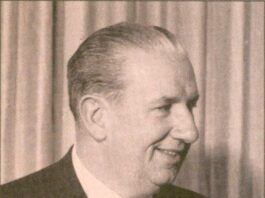
Ditching the Nash and Hudson badges and creating the AMC Rambler Ambassador in 1960-1961 was probably George Romney’s least wise move. This might not be the smartest thing he’s ever done. But it’s not destructive either. The real turning point came much earlier. Romney took over American Motors after the death of AMC president George Mason in 1954. He made a choice that changed everything. He stopped trying to take on the big three. Instead, he focused on the Ramblers.
The Ramblers found their people. Popular among buyers who value economy. In 1956, Romney redesigned and expanded the series again. In 1958, an unexpected recession hit. Sales of large vehicles have collapsed. Romney watched the numbers. He pitched AMC perfectly. This is perfect timing. Suddenly people all over the country were buying Ramblers.
American Motors has sold only 100,000 units per year for three years. After that, sales doubled. next year? They doubled again. By 1960, the Ramblers were in third place. This dislodged Plymouth. An independent carmaker has not reached such heights since Essex in 1929. The strategy is working.
So why throw away the old name? Romney wanted to signal a break. He doesn’t want to kill Nash and Hudson for nostalgia. He wanted to show that AMC was done with the past. In fact, the large Rambler-based car was still in clay until the end. It even had Nash and Hudson badges. Nash has used the name “Ambassador” for years.
When the Rambler Ambassador finally rolled off the assembly line in 1958, it was only slightly smaller than the old Hudson and Nash. The wheelbase is 4.5 inches shorter. It shed a hundred pounds. However, the AMC 327 V-8 is still in use. It had more horsepower than the big cars of 1957. It was livelier. But let’s be honest. It’s still a dinosaur that guzzles a lot of gas. Romney said he wasn’t building those anymore. He is.
“It was a hedge — a kind of failsafe,” recalls former AMC chairman Roy D. Chapin Jr. “If our small car strategy went wrong, we had the Ambassador, and we could expand on it. Small cars didn’t break, so the Ambassador kind of hung around as a sidelight.”
Chapin’s summary is apt. In 1958, the Ambassador sold exactly 1,340 units in its first year on the market. There was almost no ripple in the market. This is a backup plan and never needed to be the main plan. The small cars worked. The Ambassador lingered. footnote. side light.
But by 1960 things had changed. Rambler Ambassador was getting a second life. With Nash and Hudson’s names gone, it stands on its own. It’s bigger. More sophisticated. Trying to capture a different buyer. The previous model was a compromise. this? This must be a statement.
Style is more important now. The sales figures tell the truth. Will the market accept a big Rambler without the support of the old brand? Or is it just a relic waiting to fade away? The 1960-1961 models answer this question. the experiment continued.
9 Ways to Buy a 1960 Ambassador
Choose your body style. Pick the trim. Let’s do the math.
From 1960 to 1961, American Motors streamlined the Ambassador series into three different forms. Each has four doors. Always 4 doors. Available as a standard sedan, hardtop sedan and hardtop station wagon. The wagons got flexible, allowing six or eight passenger setups, making the order form even more complex.
Then there are trim levels. Deluxe. Super. Custom.
3 body models x 3 trims correspond to 9 permutations. If you include the luxury car models, which are technically sedans, there are eight of them. it doesn’t matter. The thing is, most of them are ghosts now. You’re looking at 302 Deluxe fleet sedans. 637 Super eight-passenger wagons. 435 Custom hardtop wagons. These numbers are small. They are collectible and rare.
The appeal of the 1960 AMC Ambassador** is not just its rarity. It’s about hierarchy.
The Customs sat at the top. Superheroes distinguish the little things that really matter to their owners. clock. Full wheel discs. Foam padding in the back means your back won’t hurt during your commute. Padded dashboard. Padded visor. Standard equipment. You don’t have to ask for it. You paid for it.
Prices for the bare-bones deluxe version start at $2,395. Prices for a fully equipped custom hardtop station wagon go up to around $3,200. General equipment customization? You are looking at $4000. That’s about $300 more than the equivalent 1957 Nash Ambassador. Inflation? perhaps. What is the reputation of the brand? Really.
A shape that expands your field of vision
The design team didn’t reinvent the wheel. They gave it a facelift.
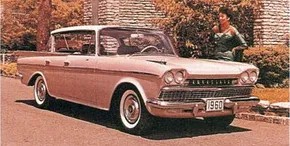
It worked. The 1960 model looked sharp. A full-width eggcrate grille dominates the front end. stand-up letters spelled out AMBASSADOR Block letters. No nonsense.
But the real trick is the glass. Composite windshield. Not only the upper part is bent. Wrap it around the sides as well. More glass. Improves visibility. Provides the driver with a wide field of vision.
Below the beltline, the full-width body side moldings run the entire length of the car. On Customs, it enclosed brushed aluminum. On Supers, it was painted two-tone color. It’s deceiving people anyway. The car looks longer. It looks wide. It looked nothing like the much shorter Rambler.
performance? Right. Not exciting.
The 327 cubic-inch engine delivered 250 or 270 bhp. That’s enough to get the job done. It’s not enough to win street races. These are not hot rods. They are not here to challenge the big Chevys, Fords and Plymouths. They were here to be sensible. They succeeded in this.
The Rambler does the heavy lifting
1960 was a great year for American Motors. They produced almost 500,000 cars. Recorded the highest volume ever. Sales are over $1
The four-door hardtop trend is fading, and AMC knows it. In 1961 these pillarless styles were discontinued. If you want an Ambassador, you’ll have to go for a sedan or wagon with a traditional B-pillar. It’s a simpler, more traditional look, but a step back from the trendsetters.
It’s even more eclectic in line-up. Little has changed, but the fleet-oriented Deluxe trim has been retained. Of these, only 273 managed to escape. Not exactly a fleet darling.
And then there’s the new Custom 400. This is a custom five-seat luxury version with bucket seats. That’s $200 more than the standard bucket seat model. The logic makes sense. Americans wanted individual seats and a manual transmission. question? AMC does not offer floor shifter. Their column shift are notoriously clumsy. You get the look, but not the feel that enthusiasts really crave.
A Radical Facelift on an Old Shell
The frame is unchanged compared to last year, but the front part has been modified significantly. The front fenders are elongated to form a prow-like nose, which one reviewer compares to an old Spanish-American War battleship. This is aggressive and maybe a bit provocative.
The four headlights have been moved outside the smaller horizontal grille. The grille is centrally located and emphasizes the sharp-nosed theme. The side trim and internal layout have also been adjusted to keep it fresh. However, the drivetrain remains the same.
Sales decline and competitors
1961 was not a bright year for anyone in the industry. Sales have dropped significantly from the 1960 level. AMC’s small cars suddenly faced stiff competition from new small cars from the Big Three: Ford, Chevrolet, and Plymouth.
Ambassadors are not immune to this pressure. Total sales were less than 19,000 units.
During the recession, some very rare variants appeared.
- Eight-passenger wagons: Sales are barely 1,000 units.
- Custom 400: Introduced late in April with only 831 buyers.
For those tracking down specs, the 1960-1961 AMC/Rambler Ambassador figures are often compiled as reference guides.
For More Info
- Classic Cars
- Muscle Cars
- Sports Cars
- Consumer Guide New Car Search
- Consumer Guide Used Car Search
1960-1961 AMC/Rambler Ambassador Specifications
The 1960 and 1961 AMC Ambassadors weren’t slow, but let’s be honest, they weren’t fast either. If you want to beat the big Chevy and Ford V8s in a drag race, you were leaving the starting line behind. Plymouth had the muscle. AMC has… ambition.
Under the hood and on the road
The heart of the Ambassador is an overhead valve V-8. The displacement was 287 cubic inches, the bore was 4.00 inches and the stroke was 3.25 inches. The power is 250 or 270 horsepower, depending on the configuration. It is good for daily driving. That’s not enough for Street Fighter.
AMC has equipped this engine with a number of transmission options, but the specs primarily focus on the mechanical layout. The suspension setup was competent. The front has an upper and lower A-arm with coil springs. The rear suspension uses a live axle supported by a 4-link arm and a coil spring. It is sturdy. Reliable. Compared to the sports cars of its time, it was not very agile in corners.
Brakes are front and rear drum types. No discs. When going down a mountain pass, you need to press the pedal lightly.
The numbers don’t lie
The wheelbase of the Ambassador is 117 inches. That’s a long platform for a car of that era. While it offers a spacious interior, it also gives a solid feel when you turn the steering wheel.
Weight ranges from 3,343 lbs to 3,592 lbs. That’s heavy for a non-truck. When you combine that kind of mass with a 270 horsepower engine, the power-to-weight ratio becomes less impressive. The standard record does not have a top speed number, nor does it have a 0-60 mph time. The data is missing. Probably because no one bothered to time it. This is not a selling point.
Background is important
Why is this important? Because in the early 1960s, things were changing. The era of muscle car is knocking on the door. AMC is still figuring out what they want to be. The Ambassador is a full-size car. Very comfortable. It is very safe. It’s not exciting.
When you study classic American cars, you lose that context. We remember Mustangs, the Chargers, the Chevelles. We don’t remember the ambassador. They were acceptable. That’s the kindest way to put it.
Related searches
People looking for this information want to know:
1960 AMC Ambassador 0-60 How fast
1960 AMC Ambassador Specifications HP
*AMC Ambassador vs Ford Falcon performance
* History of American muscle cars in the 1960s
* Explanation of classic car suspension systems