Powel Crosley Jr. didn’t start out trying to build a Volkswagen for America. He started out building crude, small cars as a teenager around the turn of the century. But he got distracted. Radio. Refrigerators. By the 1930s, he was a magnate in both industries. Cars, however, remained his first love. In 1939, he returned to the auto business with a product that was small in every way except ambition.
The Pitch: A $325 Car Sold at Hardware Stores
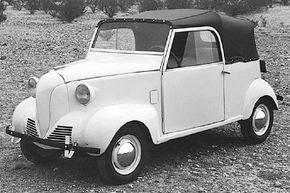
The concept was simple. Offer a tiny, two-cylinder vehicle on an 80-inch wheelbase. Price it at the lowest point in the American market: $325 to $350. It measured just 10 feet long and weighed less than half a ton. For 1939, Crosley sold 2,017 of these units. Not a flood. But not nothing.
The distribution strategy was bizarre. You didn’t go to a dealership. You went to a local hardware store or appliance shop. It was novel. It was also shortsighted. Crosley Motors built about 5,000 cars by 1942, when the government halted civilian production for World War II.
Which Models Were Available in 1939 and 1940?
For 1939, the lineup was sparse. There were only two models: a two-passenger convertible coupe and a four-passenger convertible sedan. By 1940, prices dropped to as low as $299. The lineup expanded. You could get standard and DeLuxe convertible sedans, a convertible coupe, a wood-body station wagon, and a “covered wagon” with a full canvas top. Commercial types were added too.
Styling didn’t change much. It was basic. Low, freestanding fenders dominated the look. A prominent hood bulged out ahead of small horizontal grilles in the front apron. Headlamps attached to the sides of the hood. Inside, it was barren. Just a central speedometer flanked by fuel and water gauges. That was it.
Engine Specs and The Reality of Performance
Power through 1942 came from an air-cooled, two-main-bearing Waukesha twin. It produced 13.5 horsepower from 38.9 cubic inches. On paper, that sounds terrible. It wasn’t quite as bad as the figures imply, mostly because the gearing was ultralow. Top speed hovered around 50 mph. The factory recommended cruising at no more than 40.
Fuel economy was the selling point. Crosley claimed up to 60 mpg. Few owners likely exceeded 50 mpg, but it was still impressive for the era.
The rest of the package was bare-bones. An unsynchronized three-speed gearbox. Cable-operated mechanical brakes. A six-gallon fuel tank. Sliding door windows, not roll-downs. A single hand-operated windshield wiper. Petite 4.25×21-inch tires on simple disc wheels.
Why Did Early Crosley Owners Hate Their Cars?
Cost-cutting went too far. The customary universal joints were eliminated. Flexible rubber engine mounts were supposed to make them unnecessary. They weren’t. Owners found out quickly. The cars vibrated. The drivetrain suffered.
Then there was the service issue. Crosley dealers were better equipped to fix refrigerators than cars. This combination of mechanical flaws and poor support killed sales. In 1940, volume fell by more than three-fourths, despite the expanded lineup.
The Paul Klotsch Fix: Saving the Crosley for 1941
To fix things for 1941, Crosley called in engineer Paul Klotsch. He had recently worked at Briggs Manufacturing. Klotsch got to work. He redesigned the motor mounts. He added U-joints to the driveshaft. He revised the lubrication system. He shortened the stroke and increased main-bearing surface area to improve engine durability.
The revised engine ended up at 35.3 cid and 12 horsepower. Less power, but a vastly more reliable package. Sales went up to 2,289, despite higher prices ($339–$496).
Distribution changed too. Cars were now sold through separate automobile dealers in addition to Crosley’s appliance outlets. A smart move.
No technical changes came for 1942. Prices rose again, to $468–$582. The “covered wagon” was dropped. Crosley built 1,029 cars that war-shortened model year. Then came the war. Production stopped.
The Crosley would return after the war, but that’s a different story. For now, the microcar experiment was on pause, leaving enthusiasts to wonder if the hardware store marketing would ever have worked in peace time.
CoBra vs CIBA: The Engine That Almost Killed the Brand
The CoBra engine was a wartime improvisation that worked fine in a truck fridge or a Mooney Mite airplane. It failed miserably as a car heart.
Built from brazed copper and sheet steel, this overhead-cam four-cylinder suffered from electrolysis. The metal combination created holes in the cylinder bores. Early owners faced immediate rebuilds. It was a nightmare for reliability.
Crosley fixed the problem by switching to cast iron. This new unit, the CIBA (Cast-Iron Block Assembly), kept the same 44-cubic-inch displacement and 26.5 horsepower output. The market reacted instantly. Used-car price guides gave higher trade-in values for cars equipped with the CIBA. Even retrofitted 1946-48 models saw value spikes if they had the iron block.
Postwar Boom and the 1949 Style Shift
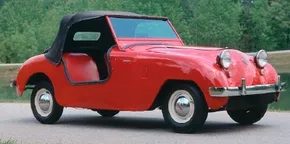
Production kicked off in June 1946. Buyers got a four-seat closed sedan first. A convertible followed. By 1947, the wagon returned. 1948 brought a delivery sedan. All were two-door models.
The cars looked more mature than their prewar ancestors. They sat on the same wheelbase but stretched 28 inches longer. Prices more than doubled from 1939 levels, yet a 1947 model still cost as little as $888.
Sales were strong initially.
* 1946: nearly 5,000 units
* 1947: over 19,000 units
* 1948: close to 29,000 units
Powel Crosley predicted 80,000 units a year soon. He was wrong.
Competition from the Big Three and other independents tightened the market. The lingering reputation of engine troubles hurt. 1949 sales plummeted below 7,500.
The Hotshot and Disc Brake Disappointment
The 1949 model was actually better built. It borrowed styling cues from the 1949 Ford. Smooth hood. Integral front fenders with sealed-beam headlights. Sedans and convertibles got remote-control door handles and turn indicators. Civilized features for a microcar.
Then came the Hotshot. A “bugeye” roadster on an 85-inch wheelbase. Priced at $849. It looked smart.
For 1950, Crosley offered wagons, convertibles, and sedans in standard and Super trims. The Hotshot remained doorless. A Super Sports version added conventional doors. Prices ranged from $872 to $984.
Engineering took a bold step. Disc brakes arrived for 1949-50. It was a first for series production, shared only with the 1950 Chrysler Town & Country Newport.
It was a mistake.
Hasty development meant the brakes rotted quickly when exposed to road salt and grime. Dealers faced service headaches. Customers remembered the sheetmetal engine woes. They didn’t want another unreliable component. Crosley reverted to conventional drum brakes in 1951.
Racing Success and the End of the Line
The roadsters didn’t sell well on the street. They dominated on the track.
Top speed hit 90 mph. Handling was excellent due to a semielliptic and coil-spring front suspension paired with quarter-elliptic rear springs. The Hotshot won the Index of Performance at Sebring in 1951.
On the utility side, the 1950 FarmORoad was a bare-bones Jeep-like vehicle. It sat on a tiny 63-inch wheelbase. Base price: $795. Accessories allowed it to tow hay wagons or dig ditches.
Buyers didn’t care.
By July 1952, Crosley abandoned vehicle production. General Tire and Rubber acquired the firm. They stripped the automotive operations after Powel Crosley spent $3 million trying to save them.