Most people think air-cooled engines are a relic, mostly associated with Volkswagens and Porsches decades later. But in the early 20th century, a small Pennsylvania company called Franklin was already perfecting the craft. They weren’t just experimenting. They were leading.
Franklin was one of the few American automakers to actually make air-cooled powertrains work reliably. From their first car in 1902 to their final exit in 1934, they built a reputation for engineering that ignored convention. While Detroit poured molten cast iron into blocks and pistons, Franklin went the other way. They used high-grade aluminum. It was lighter. It saved weight. At its peak, Franklin was actually the world’s largest consumer of aluminum.
Engineering Lightness and Smoothness
The weight savings weren’t just about materials. The suspension was equally unconventional. Most cars of that era used half-elliptic springs. They were stiff. Franklin fitted all-around full-elliptic springs instead. The result was a smoother ride and significantly less tire wear.
They didn’t stop there. A flexible wood frame softened the ride further. It sounds odd on paper, but it worked. By 1920, Franklin had already integrated features that other makers considered futuristic. Full-pressure lubrication. Automatic spark control. Electric chokes. They had abandoned four-cylinder engines after 1914, sticking exclusively to six-cylinder layouts that offered better balance and smoother operation.
The Lindbergh Effect
Aviation history gave Franklin a massive marketing boost. When Charles Lindbergh crossed the Atlantic in 1927 in the Spirit of St. Louis, he did so in an aircraft with an air-cooled engine. Franklin spotted the connection immediately. They slapped the name “Airman” on select 1928 models to honor the feat.
That same year, safety caught up with prestige. Franklins adopted four-wheel Lockheed hydraulic brakes and a rigid steel chassis. Standard “silent second” synchromesh gearboxes arrived in 1929, making shifting easier and less punishing on the transmission.
Optimism Before the Crash
Like every other Detroit manufacturer, Franklin entered the 1930s with high hopes. Wall Street had crashed, but the company had just seen record sales in 1929. Public interest in aviation was peaking. Air-cooling was no longer a gimmick; it was a proven technology.
The 1930 lineup reflected this confidence. The “145” and “147” models arrived with fresh styling. Wheelbases stretched to 125 and 132 inches, respectively. Both featured a new radiator design Franklin called a “hood front.” They knew buyers still wanted the look of a traditional grille, so they hid the functionality behind shutters. These shutters opened and closed automatically via a thermostat linked to the first cylinder, regulating airflow precisely.
Under the hood, the new engine kept the traditional six individually cast cylinders and overhead valves. The innovation lay in how it breathed. Cooling air was directed from left to right across the sides of the block. Engineers soon dubbed this “side-blast” cooling. It moved heat away from the cylinders more effectively than previous methods. The six-cylinder unit produced 95 horsepower from a 274 cubic inch displacement.
It was competent. It was advanced. But the crash had already changed everything. Sales would drop. The road ahead was narrowing.
Franklin didn’t just build cars. It built a brand identity rooted in exclusivity, and that reputation made its chassis the preferred canvas for coachbuilders. Derham, Dietrich, Locke, Brunn—these names didn’t just append bodies to Franklins; they elevated them. By the early 1930s, the lineup offered distinct flavors of luxury, each tailored to a specific aesthetic sensibility.
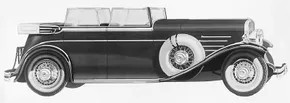
The 1930 model year introduced some genuinely striking designs. Take the Dietrich four-door Pirate. It came in two configurations: a five-passenger phaeton or a seven-seater touring car. The engineering trick wasn’t in the engine, but in the bodywork. The running boards were completely hidden behind flared door bottoms. You stepped in, not onto a board. It was a clean, modern look that screamed sophistication without shouting for attention.
Then there was the Pursuit. A dual-cowl phaeton designed with a minimalist’s eye. It ditched external door handles entirely to maintain unbroken lines. Inside, the upholstery did something unusual for the era. In the front compartment, the leather or fabric didn’t just cover the seat; it wrapped up and over the outer edge of the doors. It mimicked the cockpit design of contemporary aircraft. Franklins were literally styled like flying machines long before most people realized planes were becoming the new symbol of progress.
Dietrich also produced a popular four-door, four-seat speedster. The body was abbreviated, ending midway over the rear wheels. It was a radical silhouette for a car that prioritized comfort over speed. Most of these featured permanent canvas tops, turning them into semi-closed coupes. If you wanted full openness, you had to pay extra for a convertible option. But even then, the Franklin wasn’t a sports car.
The Aviator Connection and the Professional Buyer
It’s no surprise that aviation pioneers flocked to Franklin. Charles Lindbergh, Amelia Earhart, Frank Hawks—they all drove them. The company knew this, so it plastered these associations everywhere in its marketing. The image was clear: if you were fast enough to conquer the skies, you deserved a car that matched your status.
But here’s the thing the ads didn’t always tell you. Franklin didn’t sell cars on performance metrics. There were no drag races won by Franklins. The buyer wasn’t looking for horsepower; he was looking for reliability and prestige.
The typical Franklin owner was a physician, an attorney, or a business executive. Conservative tastes ruled. Blackwall tires were standard. Paint colors were subdued—blacks, grays, deep blues. You didn’t buy a Franklin to show off; you bought it to signal that you had arrived.
Sedans, Stability, and the Decline
Franklin was ahead of its time in one specific way. It sold more sedans than open cars before 1920. That trend never reversed. In the 1930s, when convertibles were still popular for the wealthy, Franklins remained stubbornly sedan-focused. It was conservative, elegant, and fairly expensive.
This conservatism bred loyalty. Customers didn’t just buy one Franklin; they bought several. They stayed with the brand because it offered a consistent, predictable luxury experience.
Franklin’s first-quarter 1930 numbers looked good on paper. The company claimed its share of the luxury market doubled compared to the same period in 1928. It was a boast that rang hollow as the Great Depression tightened its grip on the “fine car business.” By year’s end, 1930 sales had collapsed to less than half of 1929’s totals.
Desperate to keep the assembly lines moving, Franklin launched the Transcontinent Six (Series 141) in May 1930. It sat on a 125-inch wheelbase, offering buyers a closed coupe, convertible coupe, Victoria Brougham, or a four-door sedan.
“Riding like gliding” was the tagline. The reality was a car that few could afford.
The sedan was the entry point, priced at $2,395. That figure was absurd. A new Ford Model A cost a quarter of that. In 1930, that price tag represented a comfortable annual salary for many workers. Production reflected the economic climate: just 5,744 units sold for the entire model year.
The 1931 Pruning and the DeLuxe Six
For 1931, the lineup was stripped back. The Transcontinent Six returned with price cuts, landing between $1,800 and $1,900. At the top of the heap was the DeLuxe Six.
Priced from $2,400 to $2,700, this four-model group featured sweeping body lines by Ray Dietrich and distinctive clamshell fenders. It rode on a longer 132-inch wheelbase. Under the hood, the engine was pushed to 100 brake horsepower.
Marketing still leaned hard on aviation metaphors. Franklin promised a ride “like gliding,” trying to distance itself from the gritty reality of the Depression. It didn’t work. Model-year production withered to 2,851 units.
The Air-Cooled V-12 Experiment
Then came the gambit: an air-cooled V-12.
The engine displaced 398 cubic inches and made 150 horsepower. Franklin called it “supercharged” in ads, but it was technically using a ram-air effect generated by a duct attached to the cooling fan. The idea was to create a mighty, smooth powerplant that fit the brand’s engineering prestige.
The Twelve was originally slated for the 1931 DeLuxe Six chassis. Financial trouble delayed it to 1932. Franklin had missed payments on certain notes. Banks sent in managers to protect their investment. President Edwin McEwen saw this as a signal to pivot. The Twelve would not be a variant. It would be a new, larger car entirely.
A New Look, A New Structure
The 1932 Franklin Twelve looked like nothing else from the Syracuse factory. It shared only one trait with its ancestors: the air-cooled engine.
The suspension changed significantly. Traditional full-elliptic springs and a tubular front axle were replaced by semi-elliptics and an I-beam axle. Coachwork moved away from Walker of Massachusetts. Instead, bodies were hand-crafted in-house at the Syracuse plant.
LeBaron handled the styling. The result was sharp. A deeply V-shaped hood cover stretched back to a steeply raked windshield. It was exotic. It was magnificent. It sat on a 144-inch wheelbase, making it physically imposing by 1932 standards.
The Olympic Compromise
Exotic cars do not sell in a depression.
Sales estimates for the Twelve hovered around 200 units for the model year. The company scraped together another 1,700 or so six-cylinder “Airmans” on the 132-inch chassis. Franklin was running on fumes.
The solution was cheap. For 1933, the firm introduced the Olympic line. This was a hasty alliance with Reo, another automaker facing imminent collapse. The Olympic was essentially a Reo Flying Cloud. It used Reo’s 118-inch wheelbase chassis, but Franklin installed its own six-cylinder engine in Syracuse.
The logistics were brutal but efficient. Reo shipped 30 bodies daily from its Lansing, Michigan, factory. Those bodies arrived in New York, where Franklin installed engines and shipped the finished cars out the next day.
Because Franklin’s investment was minimal, the retail price was low. $1,385 for the coupe or sedan. $1,500 for the convertible. It was a survival tactic. Not a victory. But it kept the lights on, if only for a little while longer.
The Franklin Olympic was a genuinely competent machine, but it arrived at the party after the guests had already left. It wasn’t enough to salvage the brand. Production numbers tell the sad story of this late attempt: just 1,218 units rolled off the line in 1933. By 1934, when the model became the brand’s final act, only 109 were built.
The rest of the lineup didn’t fare much better. Franklin still offered the mechanically identical Twelve and Airman Six models during these dying years. Each came with four body styles. Volume was abysmal. Combined totals sat at a pitiful 98 for the Twelve and 468 for the Airman Six. These figures confirm that the market had already moved on, leaving Franklin’s air-cooled legacy gathering dust.
But the company didn’t just vanish into the night. The assets were purchased by a group led by former Franklin engineers. They pivoted hard. Instead of building cars, they built aircraft engines. Specifically, the air-cooled varieties that had defined the automotive division.
Helicopter engines joined the catalog in the 1940s. Then came a twist that connects Franklin directly to another famous defunct brand. In 1948, water-cooling was added to a Franklin helicopter engine. Why? To power the Tucker 48. Preston Tucker’s radical car relied on this adapted aviation tech. It was a clever reuse of existing engineering, even if the end result for Tucker was short-lived.
Aircraft engine production kept the company afloat for decades. Franklin continued manufacturing these powerplants well into the 1970s. The cars are gone. The engines remain a footnote in aviation history.
For more on defunct American cars, see:
-
AMC
-
Duesenberg
-
Oldsmobile
-
Plymouth
-
Studebaker
-
Tucker