A car engine is basically a simple beast. It converts the chemical energy stored in gasoline into mechanical power. You can do this by burning. That’s why we call them combustion engines. This process requires a precise combination of fuel and air.
Before fuel injection became common, almost all cars relied on carburetors. You may not see it much anymore. You may be wondering what exactly a carburetor is and how it works.
The role of the carburetor in mixing fuel and air
The main function of the carburetor is to mix gasoline and air in the right ratio. This is a fact that surprises many people. Liquid gasoline does not burn. It is the vapors that ignite. The carburetor sucks liquid fuel from the tank and mixes it with the incoming air. The vaporized mixture then goes into the combustion chamber. There, the spark plug ignites the mixture.
It’s all about the right proportions. The engine requires a “Goldilocks” calibration. Not too hot and not too cold. It should not be too fast or too slow. It has to be just right.
If the mixture lacks fuel, the engine runs lean. In this mode, ignition is completely prevented. Even worse, it can cause serious damage to the engine. Metal parts can overheat if there is not enough fuel to cool them.
A lean engine can cause catastrophic failure and a rich engine can choke.
Too much fuel can cause the opposite problem. The engine runs rich. It can become completely flooded and refuse to start. It runs rough and can stall when accelerating. You can see black smoke coming from the exhaust pipe. It wastes gas and produces extra emissions.
Inside the carburetor
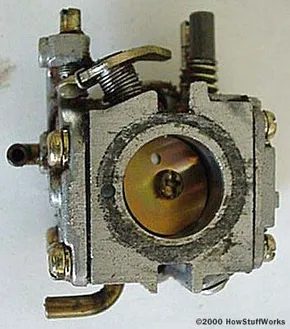
Chainsaw Curve: A Simple Crash Course
Even in the era of electronic fuel injection, many small engine machines still use carburetors (also known as carburetors). Chainsaw carburetors are simpler than others, so this is a good place to explain the basics. There are really only three situations you need to cover:
-
Must work when trying to start the engine from cold.
-
The engine must run at idle speed.
-
Must be operated when the engine is at full throttle.
Chainsaw users have little interest in the level between idle and full throttle, so the extra power between these two extremes is less important. Many layers are important in a car. That’s why car carbs are much more complicated.
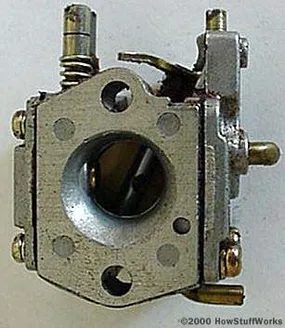
How does the Venturi create a vacuum?
The shape of the pipe is not random. This is a precise engineering constraint. Air comes in. It hits the narrow spot, the venturi, and accelerates. This acceleration causes a drop in pressure.
“A vacuum is created during this contraction process.”
The pressure drop is the heart rate of the engine. Without this, the fuel will not move. The vacuum sucks the liquid through the jet. The jet is a small brass hole in the throat of the venturi. This configuration is clearly visible in Figure 2. The jet is on the narrow left side. This is not a pump. This is not a complex electronic circuit. This is physics. Air moves fast. The pressure drops. Next comes the fuel.
Gas regulator and air flow
Upstream of the venturi is a throttle plate. This is the adjustable brass disk shown in Figure 1. It works like a dam. When opened, air circulates freely. Close it, the engine needs oxygen.
This plate directly controls the amount of air flowing through the pipe. This is the main interface between the leg and the engine air intake. Every time you move the accelerator pedal, the disc moves. Be more open. Add air. The degree of vacuum in the venturi increases. Draws more fuel from the jet.
Fuel supply mechanism
Jet is an important link in this chain. This is a small hole that allows the vacuum to suck in fuel. No jet, no fuel. It’s that simple. The size of the jet determines the amount of fuel available for combustion. Is it too small? The engine runs on lean. It can overheat. It can fail. Is it too big? It runs rich. Waste of fuel. Fouls plugs.
The interaction between the throttle plate and the jet is immediate. There are no delays. There is no software to update. Just a mechanical cause and effect relationship. Turn the plate. Air moves. Vacuum forms. Fuel is flowing.
Why accuracy is important
Carburetor tuning is not guess work. This is calibration. Venturi size, jet diameter, throttle angle, all these variables need to be adjusted. For example, a small deviation in the jet position can destroy the vacuum. The fuel is not injected properly. This affects combustion.
Figure 2 shows the position of the jet in relation to the venturi. This is not optional. It’s calculated. The vacuum must be strong enough to draw fuel, but not so strong that it floods the engine. It’s a delicate balance. If you make a mistake, the engine will stop. Even worse, runs poorly.
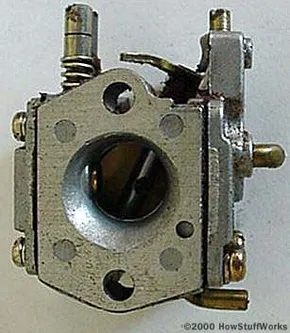
Full throttle dynamics
The carburetor works “normally” at full throttle. The throttle plate is parallel to the pipe, which allows for unrestricted air flow. This flow creates a vacuum inside the venturi. The vacuum pulls the fuel through the jet. The dose is measured. Exact.
High screw and low screw
Look at the upper right corner of the carb in picture 1. There are two screws. The “Hi” screw controls fuel flow at full throttle. This is a needle valve. By turning it, you get more or less fuel from the tip.
At idle, the throttle is almost closed. The air flow through the venturi is minimal. Not enough to create a Venturi vacuum. But what about behind the plate? Huge vacuum. The restriction creates it.
Idle Jet
Drill a small hole in the carb tube behind the throttle plate. This allows the vacuum behind to absorb fuel. That hole is the idle jet. The second screw, labeled “Lo” on the chainsaw diagram, controls the flow here.
Adjusting these screws is easy. It’s not a guess. Physically opens and closes the fuel path through the main and idle jets. A simple mechanism.
Choke Plate Logic
cold engine. Pull the rope. The rotation speed is lower. The temperature is low. The engine requires a rich mixture to ignite. The choke plate delivers.
When activated, the choke completely covers the venturi. When the throttle is wide open, the engine vacuum can’t get anywhere but through the jets. Main and idle. Consumes a lot of fuel.
This rich mixture can cause the engine to fire once or twice. Or run slowly. When the choke plate is opened, the engine switches to normal operation. This is a temporary crutch during a cold start.
What is fuel injection?
Almost all new cars use electronic fuel injection (EFI). This change started in the 1980s. Computer chips have become Inexpensive and small enough to be used in consumer vehicles.
EFI uses a computer to calculate the exact amount of air and fuel. The sensors transmit data to the ECU. engine temperature. The richness of the mixture. Oxygen concentration during intake. The computer adapts in real time. As a result, fuel efficiency improves. Reduce emissions.
Carburetor FAQ
What is a carburetor?
The goal is simple. Ensure proper fuel/air mixture. Optimum operation of the engine requires the correct ratio. There are no computers. Just physics and geometry.
Do cars still use carburetors?
Cars sold before 1990? Yes. Is it a small appliance like a lawnmower or chainsaw? Still yes. They are simple. Inexpensive. EFI is almost universally used in cars due to efficiency and emission standards. However, the carb are still a niche market.
How do I adjust the carburetor Hi and Lo screws?
They are needle valves. Turn them to allow fuel to pass through the needle. Their adjustment directly controls the flow of fuel through the idle and main jets. This is a mechanical adjustment.
What happens if the carburetor breaks?
Too little fuel? The engine runs on lean. it won’t run. Or it can be harmful to oneself. Too much fuel? The engine runs rich. Smoke comes out. It doesn’t work properly. It will be a waste of fuel. Balance is everything.