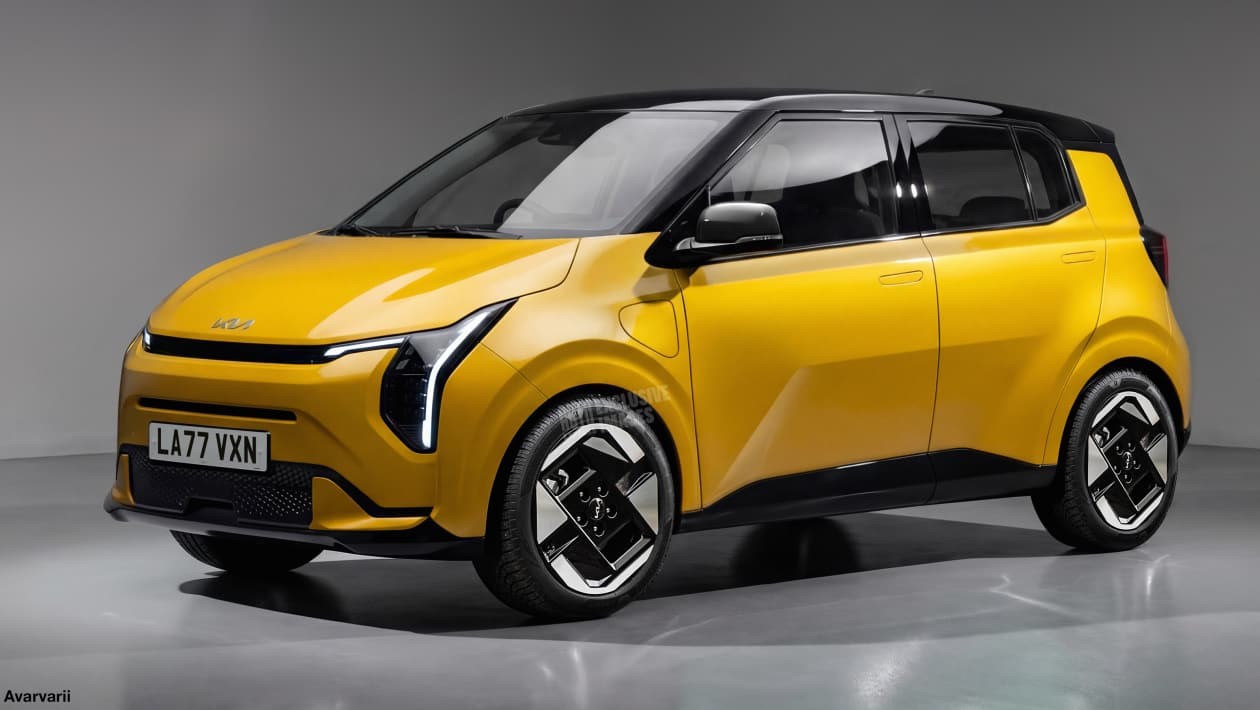
Price Tag: £17kish
Auto Express broke the story. Kia is building the EV1. It lands in 2028. Aimed squarely at the budget-conscious. And Hyundai is right behind it with something that will likely be called the Ioniq1.
It makes sense. Developing platforms burns cash. Burning cash twice burns it twice as fast. So they are splitting the cost. One architecture, two cars. Entry-level EVs don’t need proprietary gold-plated tech. They need to not cost a kidney.
The target is brutal. £17,000 or so.
Renault’s revived Twingo is the benchmark here. Starting just under €20k in Europe, probably around that £17k mark over here when it goes on sale later this year. VW is dropping an ID. Lupo in 2027 too, likely priced identically. If the EV1 doesn’t match these numbers it’s dead on arrival.
Ted Lee, Kia’s bigwig, said the price would be competitive without relying on government handouts. €20,000–22,000. At today’s exchange rates that keeps it under the £20k ceiling in the UK. One of the cheapest new cars you can buy.
Compare that to the current Kia EV2 which starts just under £25k. Or the petrol Picanto which the EV1 replaces, starting above £17k anyway. There’s barely any gap for inflation or battery costs to hide in. A lot has to stay flat between now and 2028 for those numbers to hold.
Cheap Doesn’t Mean Shoddy
Is it going to feel like plastic? Lee insists no. Quality matters. Dynamics matter. Even in a tiny car.
This thing will have next-gen tech. Software-defined. It’ll handle highway autonomy functions. Not the kind of tech that makes it slow, but the kind that keeps it modern.
They aren’t rushing. It’s been two years in the works. Renault did the Twingo concept-to-car in 100 weeks. Chinese manufacturers are apparently naming models in the time legacy brands take to draft business plans. Kia isn’t trying to beat those timelines, but it’s moving faster than you might think for a global brand.
Expect a concept car in 2027. Based on the EV2 through EV5 lineage the production model usually looks 99% identical to the concept. Don’t bet against it.
Visually, the EV1 won’t copy the Picanto. The design team ignored the old incumbent. It’s a fresh identity. Sportier than the boxy, SUV-shaped EV2. More monobox. Less SUV. Think EV4 vibes but smaller. Black plastic trim on bumpers and sills for an urban toughness vibe rather than off-road pretension. Non-radial wheels. Vertical LEDs. Maybe fewer creases, more curves, echoing the Meta Turismo concept.
Hyundai’s twin? Total contrast. The Ioniq5 and EV6 shared parts but looked like alien relatives. The Ioniq3 and EV3 did the same. Expect the Ioniq1 to do the same. It replaces the petrol i10 and probably the electric Inster too, which arrived recently and costs nearly £24k — too pricey for the city car fight.
The EV1 is global but aimed at Europe. Built in Slovakia? Possible. Same plant as the EV2.
Design: The “Kia Way”
Jochen Paesen, head of design, said small cars are non-negotiable. “We need to be noticed,” he told Auto Express.
Kia is pivoting. The minimalist, sterile aesthetic they perfected with the Ioniq/EV series is getting an upgrade. They want people to walk into showrooms and think “I want that.” Aspiration in the city segment? Wild.
Paesen admits they have to balance physical restrictions. Small boxes are hard to design when every millimeter counts and margins are razor thin. The exterior will likely push new boundaries while the interior plays it safer.
Interiors: Boring on Purpose?
Exterior excitement does not automatically translate inside. In fact, for a budget car it might actively fight against it.
Current Kia EVs share the same triple-screen layout across the dash. It looks good on launch week. Less so in the rear view mirror six months later. Paesen says they are reviewing what works and what doesn’t. Future-proofing the digital system without forcing owners to learn a new language every model change is the goal.
The EV1 will probably strip the tech out. Fewer screens. Simpler buttons. If it’s £17k the infotainment can’t cost £500 to repair.
Is There a GT Version?
Almost certainly not a monster.
Kia has turned out GT versions for the EV5, EV3, even the EV2 soon. But putting dual motors into a sub-four-meter car? Expensive. Heavy. Pointless for this market segment.
The EV3 GT makes 288bhp using four electric motors (two on each side). The EV1 GT won’t go that far. Expect a modest bump over the standard front-wheel-drive output, maybe touching or slightly beating the EV2’s 147bhp. The Picanto GT-Line showed Kia knows how to add aggressive bumpers to small cars without breaking physics. Expect big wheels. Expect neon green accents. Expect disappointment from those wanting serious horsepower.
The Competition is Weird
This is a weird race. Margins are paper thin. Only a few players care.
Renault is the main threat. The Twingo rides on nostalgia. European buyers ate up the Renault5, and they seem to want a cute EV hatch too. Renault outsourced development to Chinese partners to hit their 100-week target. A bit controversial for a French brand? Sure. Did it work? Looks like it.
VW’s ID. Lupo is the dark horse. Built on a new platform via the Rivian joint venture. Hardware and software shared. It’s not a chopped-down Polo. It’s a purpose-built contender.
Then there is the Smart #2. A two-seater. Two doors. Likely more expensive. Likely more premium. Not practical for a family of four or even two with a pram, but if you want style over space it’s there.
Will the EV1 succeed? The price looks right. The platform looks smart. The design language is evolving. But £17,004 in 2028 buys very different metal than £17,006 in 2024. Inflation is a silent competitor. Batteries are still expensive. Chips are still fragile.
We’ll see in 2028 when the concept arrives. Until then it’s just pixels and promises.
“How do we become more aspirational? How do we get people to say, ‘I want that Kia’? That’s part of our strategic thinking.”