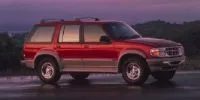
Success in the automotive industry is rarely static. By 1995, the Ford Explorer had established itself as a cultural icon, but Ford knew the crown wouldn’t stay there for long. The contestants formed a circle. The result is a comprehensive redesign that updates the styling and tweaks the mechanics just enough to keep buyers loyal. This is not a radical restructuring. It was a sharpening of an existing weapon.
The SUV market heated up in the mid-1990s. In the same year, General Motors introduced the redesigned Chevrolet Blazer and GMC Jimmy, and import brands also began to introduce serious competitors. But the Explorer stayed put. It remains America’s favorite SUV, a testament to its combination of practicality and comfort. The key? It offers a “family wagon” feel that other trucks don’t have.
Updated 1995: Smarter, Safer, Bigger
The Explorer’s first redesign came surprisingly quickly, just four years after its debut. From a truck design perspective, this is fast. Ford must face aggressive new competition.
The changes are subtle but effective. Both the two-door model and the main four-door model have been extended by approximately 4 inches in overall length, making them sleeker and more modern. The wheelbase has also been adjusted to 101.7 inches for the two-door model and 111.5 inches for the four-door model. The two-door Eddie Bauer trim was axed, which simplified the assembly.
Under the hood, the standard 4.0-liter V6 engine has been slightly enhanced. Torque is up 5 pound-feet to 225, and horsepower remains flat at 160 across all transmissions. But the star of the show is the new drivetrain technology.
Ford has introduced Control Trac, an available four-wheel-drive system that changes the way the Explorer handles the road. Previous setups required drivers to use four-wheel drive only in slippery conditions. Control Trac enables full-time four-wheel driving on dry pavement. Normally, power is sent to the rear wheels, but if slip is detected, torque is immediately transferred to the front wheels. In serious off-road crawling, the dashboard switch locks into a low gear.
Safety is also significantly improved thanks to the two standard front airbags. This put the Explorer ahead of competitors such as the Jeep Grand Cherokee and Chevrolet Blazer, which at the time only offered driver’s side airbags. Rear disc brakes replaced drum brakes, and anti-lock brakes remained standard.
Consumer Guide once again named it a Best Buy, noting that the four-door’s longer wheelbase offers a more comfortable ride and more interior space than the two-door. The V6 isn’t the most powerful engine in the segment, but it makes up for it with low-end torque and brisk acceleration. Sure, it’s noisy in the cold, but it helps the Explorer stay ahead of the crowd.
1996: Added V8 muscle and all-wheel drive
The competition never ends. In 1996, Ford responded to buyers’ demands for more power by adding a V8 engine to its four-door models. This is more than just a token swap. It’s a proven 5.0L/302 cubic-inch overhead-valve V8.
This engine is tuned to produce 210 horsepower and 280 pound-feet of torque, which is 50 horsepower and 55 pound-feet more than the V6 engine. The payoff? An optional towing package increases the maximum towing capacity from 5,000 pounds to 6,500 pounds.
Ford was smart with this engine. The V8 was only available with a four-speed automatic transmission. It is also the only engine paired with the new All-Wheel Drive (AWD) system. Unlike the Control Trac 4WD, this AWD has no low-range gear. It typically splits power 35/65 front and rear, but torque can be varied as needed to restore traction. Control Trac 4WD remains optional on V6 models.
The integrated child safety seat, which folds down from the back of the back seat, also increases the comfort of use. This is only available on four-door cars and is a smart choice for families.
Ford sought to expand on its success with the Mercury Mountaineer, an upgraded luxury version of the four-door Explorer sold through Mercury dealers in 1996. Available in rear or all-wheel drive, it was equipped with a V8 engine and looked almost identical to the Ford. The car’s slow sales may be due to rising prices and confusion as to why buyers are willing to pay more for the same car.
1997: Camshaft top replacement
By 1997, the goal was wider appeal and modernization. Ford has introduced a new Overhead Cam V6 engine to replace the aging overhead valve unit in higher trims.
This 4.0L OHV to OHC swap shares the same cylinder block but differs in almost every other mechanical way. It produces 205 horsepower and 245 pound-feet of torque, up 45 horsepower and 20 pound-feet from the old V6.
This new “cammer” V6 became standard on four-door Eddie Bauer and Limited models. It was optional on other trims. This is mated to a new 5-speed automatic transmission. Ford claims the transmission is maintenance-free under normal conditions, a significant improvement in comfort. The older OHV V6 engine also has a 5-speed transmission.
A four-speed automatic transmission is still mandatory on V8 models. An electronic transfer case was also introduced to improve the transmission.
The Explorer wasn’t just keeping up; They adapt. More effective, more efficient and more comfortable. However, the SUV war has only just begun.
Electronic Control Trac and the Expedition Boom
The Control Trac four-wheel drive system’s electronic transfer case not only tunes performance, but also redefines the agility of a V6 model. It prioritizes power transmission to the axle with the most traction, but a subtle “Auto 4WD” mode is introduced. This setting distributes 10% of the torque to the front wheels and 90% to the rear wheels, a configuration designed with efficiency in mind. Drivers can also lock the 50/50 split on all four wheels for even more traction. Low-gear transmission remains important, and most importantly, the system allows for high four-wheel engagement on dry pavement. This is the feature that separates modern utility from older, locking hubs.
Ford’s strategy to extend the Explorer’s success into the full-size segment quickly paid off. 1998 Ford Expedition, Built on the durable F-series pickup platform, the 1998 Ford Expedition, didn’t just enter the market. It dominated. The Expedition took less than 12 months to outsell competing full-size SUVs from Chevrolet and GMC combined. The formula works: family-friendly space and truck durability.
1998: Two-Door Exodus and Safety Shifts
By 1998, the market had spoken. This two-door SUV is becoming a niche novelty in the sea of four-door cars. Ford responded by discontinuing the two-door XL model altogether, leaving only the sporty badge trims. The Explorer still offers one of the few two-door options, but word is on the wall.
The federal government has paid even more attention to safety. All 1998 models were equipped with a standard anti-theft system and the more controversial “depowered” front airbags. These new developments are a direct response to the increase in injuries to children in short drivers and underpowered passenger seats. Exterior updates are subtle, including redesigned taillights, deeper tailgate windows and a refined bumpers. Top-spec Limited and Eddie Bauer trims come with steering-wheel-mounted audio and climate controls, a useful feature that anticipates the interior tech wars to come.
Demand has slowed slightly, prompting discounts, but the Explorer still accounts for a quarter of all midsize SUVs sold. The Dodge Durango is a new Challenger based on the Dakota pickup truck. It’s attractive, but lacks the sales force to threaten the Explorer’s throne.
1999: Awareness of danger
The year 1999 brought active safety technology to the fore. Front side airbags are installed on the outer bolsters of the front seat backs and are available as an option for all models. Its purpose is very clear. This is intended to protect passengers from side impacts.
Also new is the Reverse Sensing System, which is optional on all models except the base XL. This system uses a radar-based sensor in the rear bumper that provides an audible warning when the vehicle approaches a target within 6 feet. This is an important feature in a high-riding SUV with large blind spots. Prevents accidents with children that cannot be solved with traditional rear view mirrors. Notably, Ford discontinued the optional integrated rear child seat around this time, probably realizing that its complexity outweighed its practical value.
On the outside, there is an improved front bumper that gives it a more tougher look. Limited models have more wood-grain interior trim and standard 16-inch wheels. Illuminated running boards are standard on Limited and Eddie Bauer, and load-leveling suspension is optional on XLT and higher trims. The base XL comes with the XLS accessory package, which bundles the power equipment with off-road tires and chrome rims.
2000: The Excursion’s Shadow and the Firestone Crisis
Although Explorer product development slowed in 2000, the industry did not. The Ford Excursion, based on the Super Duty truck chassis, has been arrived. It’s the largest SUV ever made, and it’s longer, taller and heavier than the Expedition and other GM offering. Even the military-grade Hummer H1 looks small when placed next to it.
Environmentalists and commentators have criticized the Excursion’s size and high fuel consumption. Buyers agreed. Sales did not meet expectations and it was discontinued after the 2005 model year.
However, the year 2000 was marked by a crisis. Firestone Tire Recall implicated the Explorer in rollover accidents that killed nearly 300 people. Ford and Firestone engaged in a public blame game before Congress that ended with Ford paying $3.5 billion to replace 6.5 million tires. Although this was the right move financially, it seriously damaged its public image. Explorer sales plummeted, Ford’s reputation suffered, and it would take years to fix.
2001: Sport Trac Experiment
The Explorer was redesigned in 2001, but the real story is the Ford Explorer Sport Trac. The vehicle is a four-door “crew cab” pick-up truck with a wagon-like cabin and open bed that was introduced in January 2000 as a 2001 model.
This extends the Explorer’s wheelbase by 14 inches to 125.9 inches and its overall length by 15 inches to nearly 210 inches. The enclosed cargo area of the SUV has been replaced by a four-foot bed with a drop-down tailgate. Flared fenders and body-colored composite plastic give it a rugged aesthetic. An optional pivoting tubular cage extends the bed length by 23 inches with the tailgate down, providing multiple hauling options. A contoured liner and 12-volt outlet make it practical, and an optional two-piece locking hard tonneau cover adds extra safety. It was a bold attempt to combine the lifestyle convenience with the work-capable utility, an area that Ford continued to pursue for decades to come.
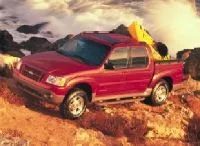
Inside the Sport Trac, Ford did more than just attach a truck bed to an SUV. It has a specially designed interior. You got exclusive low-back front bucket seats. A removable soft-sided pouch is used as a storage space in the center console. The rear was a split-folding three-passenger bench in the back.
Standard equipment includes an power rear cab window with electric defrosting. The controls are manual, but very clever. Raise or lower the glass completely by turning the knob on the dashboard. A gentle push of the knob lowers the glass 1.5 inches for ventilation. It’s simple and effective.
Explorer Sport and V6 only strategy
In addition to the Sport Trac, the updated two-door Explorer Sport was also launched. It shared the new front-end look. White-faced gauges are a unique feature of this trim.
Ford tightened the requirements. Both the Sport Trac and the 2-door Explorer are available in one trim level. This required an overhead cam V6 engine. A 5-speed automatic transmission is standard.
No V8 option. The buyer must choose rear-wheel drive or four-wheel drive. This is a simplified configuration.
The four-door Explorer wagon remains largely unchanged in model year 2001. The model year has been shortened. Ford is preparing to release the redesigned 2002 version early. The wait is almost over.
Enter the Compact Escape
Ford wasn’t done expanding its SUV portfolio. They released the compact Escape. A four-door unibody wagon. It’s a direct answer to the Honda CR-V and Toyota RAV4.
The Escape is also sold as the Mazda Tribute through Ford’s Japanese affiliate. It’s a stark contrast to the massive Excursion. Both critics and buyers liked it.
Consumer Guide gave it a strong Recommended endorsement. They call it “full, roomy and comfortable and fun to drive.” It is not designed for serious off-road driving. But as Consumer Guide points out, it’s a “eminently sensible alternative” for a midsize SUV. Trucks in particular are a waste of space and fuel.
These include the four-door Explorer. So is Ford competing with itself? not much. They serve a new group of buyers. People who want the style and practicality of an SUV in a more economical, clear and affordable way.
Reliability and buyer resources
For more information on reliability ratings and safety recalls for 1995-2001 Ford Explorer models, check the next page
Before you buy, do your due diligence. Used car market data is important. Consumer Guide used car reviews provide expert analysis of thousands of vehicles from the past 10 years.
When a particular Ford Explorer is for sale, the vehicle history report is non-negotiable. Indicates whether the odometer is accurate. It confirms if any safety recall repairs have been completed. There are other important details as well.
The Ford Explorer has been a popular choice on Consumer Guide’s Best Buy and Recommended Vehicles lists for years. It is important to understand why. It helps you identify other top new-car values.
The market is changing. Tastes change. But the core charm of a capable, versatile SUV remains. It depends on your real needs, whether you choose a rugged Sport Trac or a efficient Escape. The 2001 lineup offered distinct paths. One path led to utility. The other to efficiency. Both wore explorer’s badges. Just different flavors.